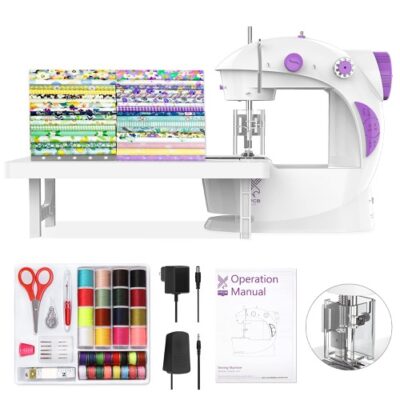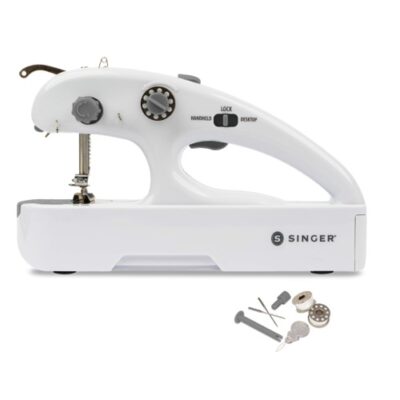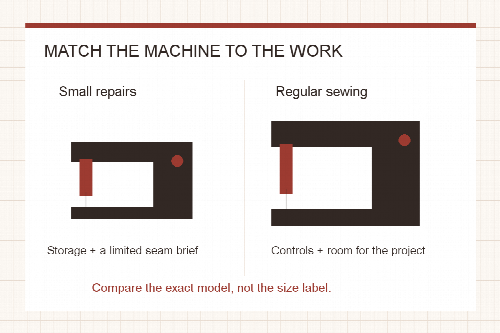
Choose a mini sewing machine when occasional light repairs and limited storage are the main requirements. Compare full-size beginner machines when you expect to sew regularly, use varied seams or handle larger pieces. The difference that matters is the work each exact model can support, not whether the word “portable” appears in the title.
Three decisions to make first
List the next three projects
A light sleeve repair, a fitted garment and a bulky bag ask different things of the machine.
Include your hands and the fabric
Shelf dimensions cannot tell you whether you can thread the needle, change a bobbin or guide the intended seam comfortably.
Count the missing essentials
Use current offers and the supplies you actually need. A large starter kit does not establish long-term value.
Mini, portable and handheld mean different things
A tabletop mini generally aims to reduce the machine’s footprint and weight. “Portable” is a broader label: many conventional domestic machines can be carried and stored. A handheld stitcher is a separate form of tool, with its own stitch construction and handling requirements. Do not combine all three into a ranking based only on size.
There is also variation within minis. The Magicfly Mini listing specifies a fixed forward straight stitch without reverse. The Rxmeili 12-Stitch listing adds selected patterns and reverse. A claim that all minis have one stitch, or that all of them have reverse, would therefore be wrong.
On a narrow screen, scroll across the table to compare all columns.
| Requirement | Why a mini might fit | When to compare full-size |
|---|---|---|
| Occasional light mending | Easy storage may outweigh a restricted set of controls. | Your repairs repeatedly involve awkward folds or difficult access. |
| Learning the first seam | A suitable mini can teach basic guidance and setup. | Small guides or abrupt starting make learning harder. |
| Making garments regularly | Possible tasks depend on the exact stitches and materials. | You need dependable adjustment, seam finishes and room for repeat work. |
| A shared room or table | A compact package can be packed away quickly. | A carryable conventional machine also fits the storage you have. |
| Large or bulky pieces | An external table may support part of the cloth. | The internal opening and foot clearance constrain the actual construction. |
Write a seam requirement instead of a fabric wish list
“I want to sew cotton” is incomplete. A flat strip of cotton and a hem crossing a folded side seam are different constructions. Identify the folds, intersections, fastening and finish for the first project. Then ask whether the exact machine’s manual and a demonstration support that job.
Similarly, a straight-stitch repair does not establish that the same machine can make every seam in a stretch garment. Check the required stitch behavior and the documented patterns. More stitch icons are useful only if they include the functions your construction needs and you can select them correctly.
No model’s household or heavy-duty label proves unlimited capacity. A full-size machine may offer more working room and adjustment, but its suitability still depends on the exact design. Compare actual controls and instructions rather than replacing one marketing assumption with another.
Make speed and stopping a personal check
Some minis offer two selected speeds and an on/off pedal. Detailed Magicfly and Rxmeili owner accounts describe that behavior. A buyer expecting a smooth increase in pace from foot pressure can find it unfamiliar. Conversely, a buyer who prefers a button may appreciate having both hands free once the machine is running.
Full-size is not a guarantee of a speed slider or programmable needle stop. Those functions depend on the model. At a demonstration, ask to start gently, sew a short marked line and stop where intended. Repeat it yourself rather than relying on the demonstrator’s experience.
Storage convenience and working convenience are separate
Measure the complete stored package, including table, pedal and case. Then measure where it will be used. Short leads, a moving pedal or a table edge far from an outlet can erase the advantage of a small body. The owner files for the blue Ninonly and Rxmeili include cord and control-placement concerns worth checking in a shared workspace.
An extension table increases the surface outside the machine. It does not enlarge the opening to the right of the needle, raise the foot further or add a different feed system. That distinction matters if the reason for buying is handling a larger piece or crossing a bulky join.
Access matters for maintenance too. Ask for the exact replacement needle and bobbin specification, where to obtain them and which cleaning steps the owner is permitted to perform. Parts that look alike are not automatically interchangeable. A starter bundle solves the first supply purchase, not every future replacement.
A cheap trial can still be an expensive detour
Compare current machine prices together with the cost of missing supplies, support and your time. We have not used unverified prices to calculate savings here. If a mini only covers the first practice session and your next three projects already need a broader machine, a second purchase may be predictable rather than a surprise.
A used conventional machine can be another route, provided its condition, completeness and service needs are checked. It is not automatically a bargain. The same practical standard applies: a correct setup, the required stitches, a controlled seam and a clear way to obtain help.
A sewing machine has a moving needle and powered controls. Follow the exact manufacturer instructions and supervise children appropriately. Magicfly’s own manual explicitly says its Mini is not a toy; a child-friendly color or a guard does not change that requirement.
Choose a direction you can explain in one sentence
“I need occasional straight repairs and one small storage box” is a clear reason to inspect a limited mini. “I want to make clothes every week and learn different finishes” is a clear reason to compare a conventional beginner machine. An uncertain future hobby can justify a modest start, but it should still provide a usable sewing experience.
Use the mini-machine shortlist for a deliberately compact choice, or the beginner shortlist for a broader sewing plan. Once a mini is chosen, the setup and first-seam guide helps check whether it works beyond the supplied factory sample.