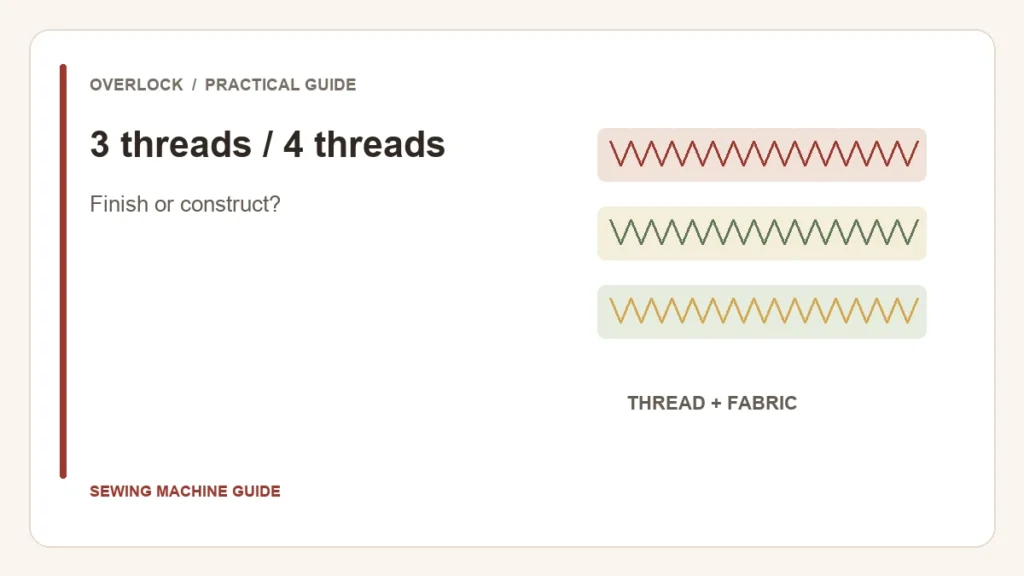
Use the seam’s job to choose the thread configuration. A typical three-thread overlock uses one needle and two loopers; a four-thread overlock adds a second needle thread. Finishing an already sewn allowance and constructing a garment seam are different decisions.
| Question | Three-thread starting point | Four-thread starting point |
|---|---|---|
| What is the job? | Finish a raw allowance or suitable lightweight edge | Join layers with a supported construction stitch |
| How many needle paths? | One, in the position specified for the stitch | Two on a conventional domestic four-thread setup |
| What must be tested? | Coverage, fraying and bulk | Seam security, stretch and recovery |
BERNINA’s overlock-stitch explanation distinguishes three-thread finishing from the additional seam security of four-thread overlock. The count does not make every three-thread seam unsuitable or every four-thread seam appropriate: fabric and the selected formation still matter.
Start with the construction order
For a woven skirt with a separately sewn construction seam, the overlocker may only need to neaten the allowances. Ask whether those allowances must press open before joining them together. Finishing both layers as one changes that option, even if the edge looks tidy.
For a knit side seam intended to stretch with the wearer, evaluate the documented construction stitch on the actual knit. An edge that looks smooth while flat can still open or break when the garment moves. Test both appearance and movement before trimming the project’s allowance.
Changing the count requires a complete setup
- Select the named stitch in the manual, not simply “one fewer spool.”
- Follow its needle position, threading order and tension starting points.
- Remove an unused needle when the exact instructions require it; do not leave a loose thread path hanging.
- Keep pins and clips away from the cutting and needle areas. The knife can remove fitting room immediately.
The BERNINA threading lesson illustrates why the selected needle and stitch-finger settings belong to the conversion. Its numerical settings are not universal instructions for other sergers.
Choose the formation, then the machine
If you mainly finish woven allowances, a useful three-thread setup matters more than the largest advertised thread count. If knit construction repeats across your projects, investigate the four-thread formation and feeding controls. Compare the work still needed on a conventional sewing machine before expecting an overlocker to complete zippers or buttonholes.