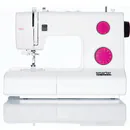
The Pfaff Smarter 160S makes its strongest case for garment sewing through its one-step buttonhole and adjustable mechanical controls. It is not a computerized Smarter model, and the Pfaff name alone is not evidence of an integrated dual-feed system.
We checked the manufacturer’s 130S/140S/150S/160S family manual model by model. This review interprets those documented differences; it does not report an in-house sewing or durability test.
The meaningful step up from the 140S
| Function | 140S | 160S |
|---|---|---|
| Buttonhole | Four-step sequence | One-step operation |
| Stitch-chart entries | 21, including buttonhole | 23, including buttonhole |
| Straight-stitch needle adjustment | Center toward right | Center toward left |
The two additional chart entries are less important than the buttonhole workflow for someone making shirts, closures or repeated openings. The needle-position difference is also worth noticing when following a zipper or topstitching demonstration made on the other model.
Three controls to learn before a garment
Stitch length, width and presser-foot pressure are separate adjustments. The manual gives a maximum length of 4 mm and width of 6 mm, with pressure guidance for different material behavior. Pressure is not thread tension: one concerns contact with the fabric; the other concerns the thread balance.
Make a normal seam on a scrap of the project fabric before changing those settings. Record the result, then check a folded edge or interfaced section. This reveals whether the setup remains useful at a real transition without pretending that a domestic machine should sew any stack placed underneath it.
The top-loading bobbin and built-in threader provide convenient access, but neither removes the need to follow the take-up and bobbin thread paths. See the threading walkthrough if the first sample develops loops.
What the one-step foot does not decide for you
A one-step system reduces selector changes; fabric stabilization, positioning and a suitable opening still need attention. Test the actual button and fabric combination before cutting the garment. A successful buttonhole on plain cotton does not establish the same result on an elastic or bulky facing.
Check that the correct automatic buttonhole foot and other promised accessories accompany the specific 160S. Family manuals include equipment and functions for several variants, so a photograph of a sibling’s carton is not an inventory.
Choose it for repeatable tasks, not brand mythology
The 160S is a sensible model to investigate when direct dials, pressure adjustment and one-step buttonholes match recurring garment work. Its case is weaker if the buyer primarily wants electronic stitch selection or an assured industrial feeding capability. Our control-style guide helps separate those requirements.
Source checked September 9, 2026: Pfaff Smarter family instruction book, stitch charts on pages 9–10 and control instructions on pages 18 and 21–22. Current price, unit condition and seller extras remain offer-specific.