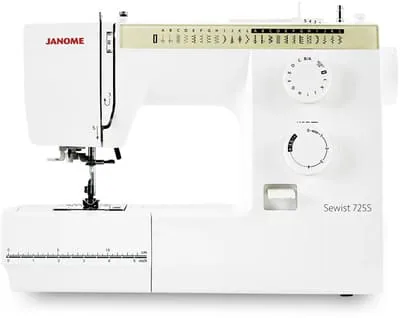
The Sewist 725S suits a buyer who wants direct mechanical controls for home sewing. Its appeal is the operating routine: choose a stitch with the dials, set the fabric up correctly and control the pace with the pedal. It is worth comparing on that basis rather than assuming that mechanical construction guarantees durability.
The controls that matter for clothes and repairs
Buttonholes and small openings
Janome lists 23 stitches, a one-step buttonhole and a free arm. That combination addresses different tasks: forming a button opening and reaching a cuff or trouser leg.
Fabric feeding and setup
The documented adjustable foot pressure, top-loading bobbin and built-in needle threader are useful setup features. Extra foot lift gives room to position material; it does not prove that every thick seam will feed successfully.
The Janome product page and manual list a maximum 5 mm stitch width and 4 mm stitch length, drop feed and an included hard cover. Confirm the feet and accessories supplied with the actual offer.
Simple controls attract owners; test the buttonhole
- Lisa likes the simple features, and Jane Sholders wanted a straightforward companion to a computerized machine. Joel White describes satisfactory basic home sewing while distinguishing it from commercial work.
- Ellen Fournier reports noise and a nonworking buttonhole that led to a return. Virginia G likes the sewing but describes a bobbin-holder problem. These individual reports support testing the intended stitches and seeking support for faults; they do not establish a defect rate.
These are individual reports on the SewingMachinesPlus product review page.
Pros & Cons Analysis
Benefits
- The preference for uncomplicated controls is supported by Lisa and Jane’s comments. For someone who already owns a computerized machine, simplicity can be a reason to choose this as a companion rather than pay for more menus.
- The documented buttonhole and free arm serve practical garment tasks; check them against the garments you expect to make rather than the total stitch count.
Limitations
- The reported buttonhole and bobbin-holder faults concern basic operations. Complete those checks early and contact support if they fail; do not treat a favorable straight seam as proof that every function works.
- Heavy-material suitability remains project-specific. A household machine, an extra-high foot lift and a positive owner report do not establish an unlimited thickness rating.
An arrival test that answers the buying question
- Sew the intended straight and zigzag seams on scraps from your project, including the actual folds.
- Make a complete buttonhole using the correct foot and instructions before cutting the opening.
- Check reverse, bobbin pickup and pedal control. If something jams or behaves inconsistently, stop and use the seller or service channel instead of forcing it.
Our Verdict
Choose the simpler routine deliberately
Consider the 725S when accessible mechanical controls and ordinary garment functions are the priority. Test the buttonhole and your real seam construction before committing to a larger project. The available owner feedback supports the appeal of simplicity, while giving enough reason to make functional checks part of the purchase.