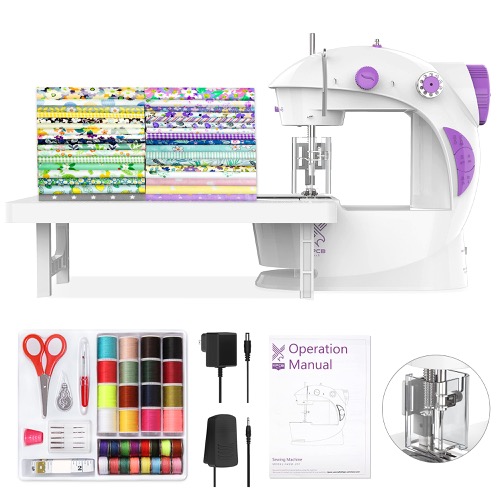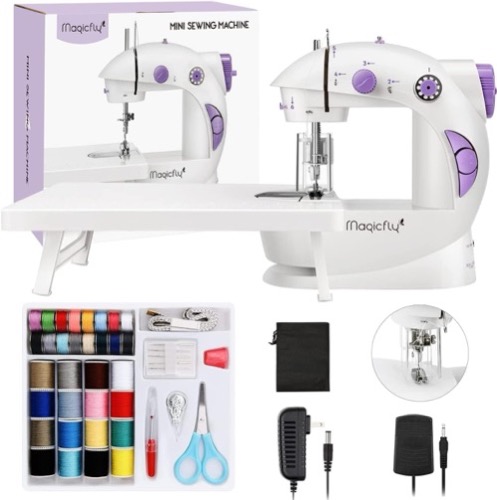
The original KPCB Mini and Magicfly Mini are small straight-stitch machines. Neither earns a recommendation simply because the box contains many accessories. Compare the exact machine, the instructions you can follow and the space needed to support fabric before counting tools or practice pieces.
Identify the original KPCB model
This comparison covers KPCB ASIN B07GX87P1K and Magicfly ASIN B07MQTP258. It does not transfer features from KPCB Mini 2.0 or another bundle. The KPCB brand site describes the original 201 family as a forward straight-stitch machine; the exact Amazon kit has its own contents. Different accessory totals do not prove a different sewing mechanism.
On a narrow screen, scroll across the table to compare all columns.
| Buying question | Original KPCB Mini | Magicfly Mini |
|---|---|---|
| Stitching requirement | Basic forward straight stitching; no reverse | Basic straight-stitch format; do not expect a full pattern selector |
| Kit value | Listed practice fabrics and tools can help a first sample | Assess the exact supplied accessories against what you already own |
| Learning support | Check the matching manual and original-model demonstration | A manufacturer manual is available for identifying setup and controls |
| Fabric support | Owners report both useful small projects and unstable table support | Check the complete table and base arrangement before feeding a garment |
Read a kit as a learning resource
Practice pieces are useful when they let a learner make an inexpensive first seam. They do not establish that the machine will sew an adult garment or its thickest folded hem. Likewise, a large accessory number can include small consumables rather than additional capabilities. Count the items you would otherwise need to obtain, and verify that the supplied needle and thread suit the practice fabric.
The KPCB family page and its exact Amazon listing describe different bundle contents. That is why our KPCB review keeps the ASIN visible. A seller photograph of a finger guard or a table should be checked against the selected package; do not infer every regional kit contains the same pieces.
What the owner accounts suggest
Selected KPCB accounts describe curtains, patches, doll clothes and pajamas. These examples support considering it for small, bounded work. Other selected accounts describe repeated rethreading, tension trouble, a failed pedal and a table that buckles. One failure followed a fall, which we do not count as evidence of spontaneous breakdown.
The Magicfly review similarly separates the convenience of a small starter setup from the work of threading and stabilizing fabric. We do not have a controlled head-to-head trial establishing which machine lasts longer. A longer owner file, a bigger kit or an isolated successful project cannot supply that comparison.
Try the whole working arrangement
For the Magicfly, the setup guide links its manufacturer manual and keeps model-specific directions separate. For either machine, thread breakage or a moving needle with no seam belongs in the symptom guide; adding force or experimenting with power supplies is not a sensible learning step.
When to choose a different class
If reverse, repeated zigzag work or large fabric support is already on your list, start with the mini versus full-size guide. Buying either straight-stitch kit and immediately working around its missing functions is unlikely to simplify the project. A kit can be a useful introduction when its limitations match the lesson; it should not dictate what you can make next.