Choose a teaching setup before choosing a small machine. A beginner needs to see the needle area, reach the controls comfortably and understand how sewing starts and stops. A finger guard and a small body can help with parts of that arrangement, but they do not make powered sewing an independent activity for a child.
Start with the adult’s familiarity
The supervising adult should be able to thread the exact machine, remove the work and respond to a jam before the first lesson. Learning together can be enjoyable, but two people guessing at an unfamiliar powered mechanism is a poor starting arrangement. Read the matching instructions and rehearse the routine with suitable scrap.
Start and stop deliberately
Practice control before aiming for a long straight line. Small pedals can behave as switches.
A simple seam on manageable pieces
Choose fabric that is easy to support and a task whose result does not depend on stretch or thick intersections.
Check the physical arrangement
| Checkpoint | A useful question |
|---|---|
| Visibility | Can both people see the needle and thread path without leaning into the moving area? |
| Control reach | Does the pedal sit comfortably, with cables out of the way? |
| Fabric support | Can the learner guide the work without its weight pulling the machine? |
| Recovery | Can the adult disconnect power and rethread without forcing small parts? |
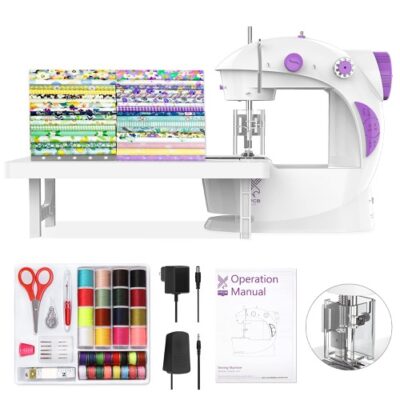
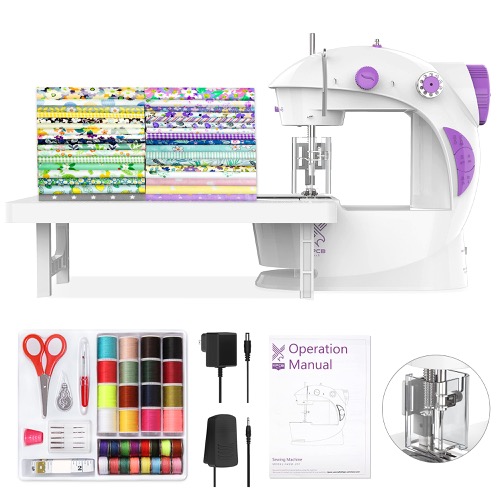
The original KPCB Mini includes a listed guard and practice squares. Those make a useful lesson starting point, but its lack of reverse remains a sewing limitation. The Magicfly Mini also requires a deliberately small project brief. Neither review establishes a universal suitable age.
Do not confuse automatic running with a broken pedal
On some minis, the selected low/high position starts powered sewing and another position enables the pedal. On other machines the arrangement differs. Establish the exact behavior rather than using a generic mini-machine video. Disconnect adapter and battery power before working around the needle.
If the machine will not stop as expected, binds repeatedly or has a damaged needle, pause the lesson and resolve the fault. Frustrating or abnormal operation is not a test of the child’s patience or ability.
When a larger machine is the better teaching choice
A larger body can offer more room to thread, steadier fabric support and clearer controls. Its greater size does not automatically make it more intimidating. If the learner wants to make garments regularly, compare the beginner-machine shortlist and the mini versus full-size guide before committing to a limited mini.