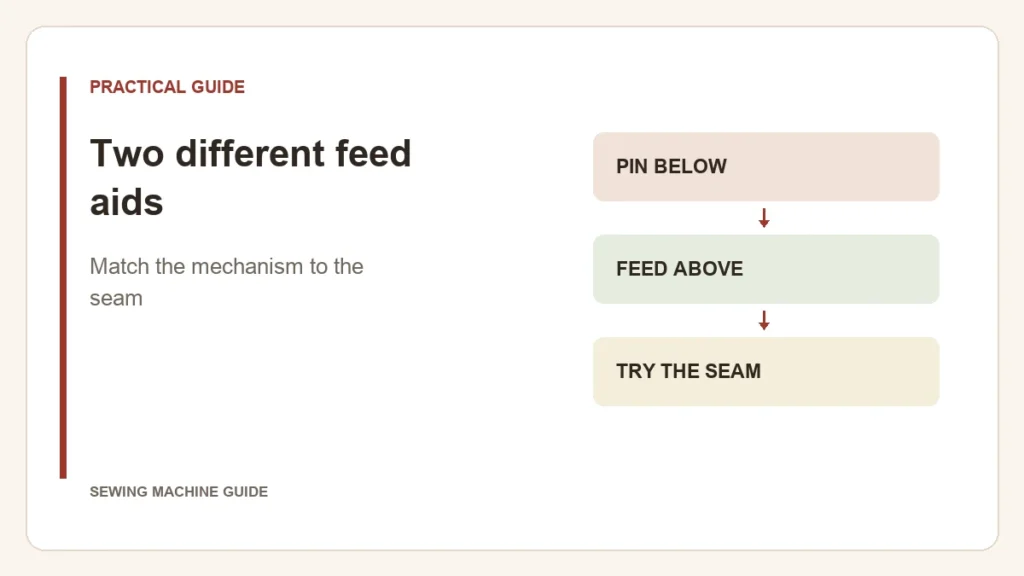
Pin feed acts from below the work; a walking-foot attachment adds an upper feeding action. They address fabric transport in different ways. Neither name, on its own, proves that a machine can penetrate your thickest seam.
| Mechanism | Where it acts | What must match |
|---|---|---|
| Pin feed | A synchronized pin below the work, in the designated feed mode | The machine’s selected mode and permitted foot |
| Walking-foot attachment | An upper action working with the machine’s feeding | The exact compatible attachment, installation and allowed settings |
The Brother example has specific restrictions
On the PQ1600S, Brother’s feed-dog instructions distinguish the pin position from the other heights. The permitted feet for that mode are the pin-feed or general-purpose foot. Do not combine a raised pin with an unfamiliar attachment simply because both are advertised as feeding aids.
The Juki TL-2010Q uses a different arrangement. Describing both models as suitable for layered work does not make their mechanisms interchangeable.
Check whether the layers stay registered
- Mark matching points on two strips of the actual fabric assembly, including the planned lining or interfacing.
- Have the documented mechanism and compatible foot set up for that material. Sew without pulling either layer.
- Compare the marks and ends, then inspect both faces for surface marks and the seam for distortion.
Include a seam crossing if the project has one. If the layers remain aligned but the machine cannot cross the join, feeding alignment and material capacity have produced different answers. Do not treat success on the first as proof of the second.
Free motion changes who moves the fabric
With feed-guided sewing, the mechanism advances the work. In free motion, the operator moves it under the documented foot/feed setup. A pin-feed or walking-foot comparison therefore does not decide your quilting technique.
Choose a feeding aid when it improves a visible problem in your material: alignment, advance or surface handling. Use a separate assessment for penetration, clearance and the controls you need to keep a comfortable pace.