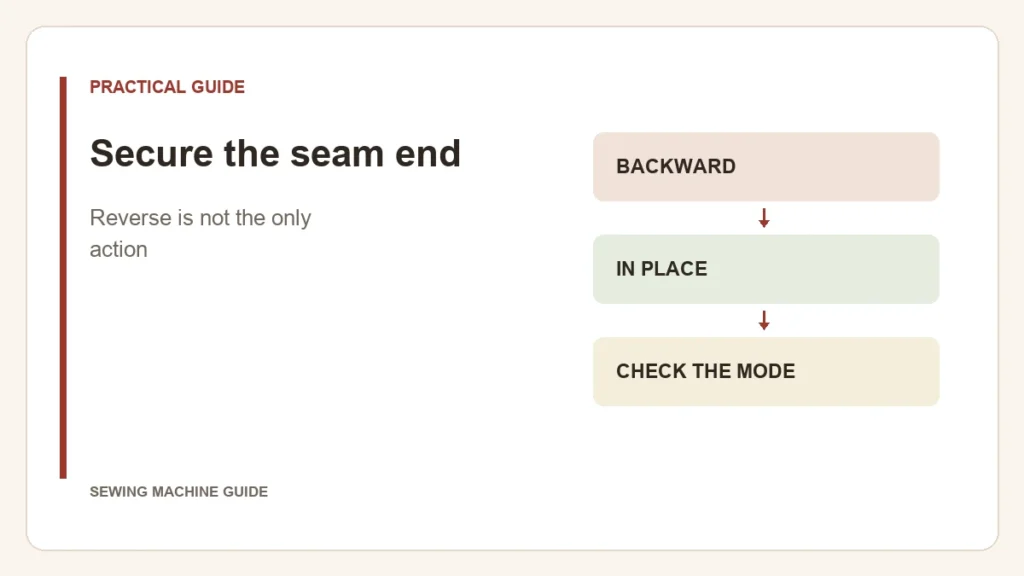
Watch what the fabric does when the securing control is pressed. If it travels backward over the seam, the machine is reversing. If it stays in one place while several stitches form, it is reinforcing in place. The same button may do different things with different stitch selections.
Three operations at a seam end
Reverse → reinforce → trim are not interchangeable
- Reverse: stitches travel back over a section.
- Reinforcement in place: stitches secure a point without the same backward travel.
- Trimming: threads are cut; that alone does not establish a secure end.
Brother’s SE700/SE725-family instructions describe reverse movement and three to five reinforcement stitches in one place, depending on the pattern. That count belongs to the documented example, not every machine’s locking function.
Choose the action from the stitch chart
| Situation | Question to settle before sewing |
|---|---|
| Ordinary plain seam | Which documented securing method suits the fabric and construction? |
| Decorative motif | Does the control complete the motif before reinforcement, or stop it where pressed? |
| Automatic end sequence | Is reinforcement enabled, and does it happen before cutting? |
| Delicate or bulky edge | Does the selected method hold without creating an excessive lump or drawing the edge into the plate? |
Try the selected sequence on the actual fabric and inspect both sides. More repeated back-and-forth stitching is not automatically better. Choose the least bulky documented method that produces a sound end.
An overlocker uses a different thread chain and generally does not follow this reverse-sewing routine. Use the serger seam-end methods for that mechanism rather than trying to imitate a domestic machine’s button sequence.