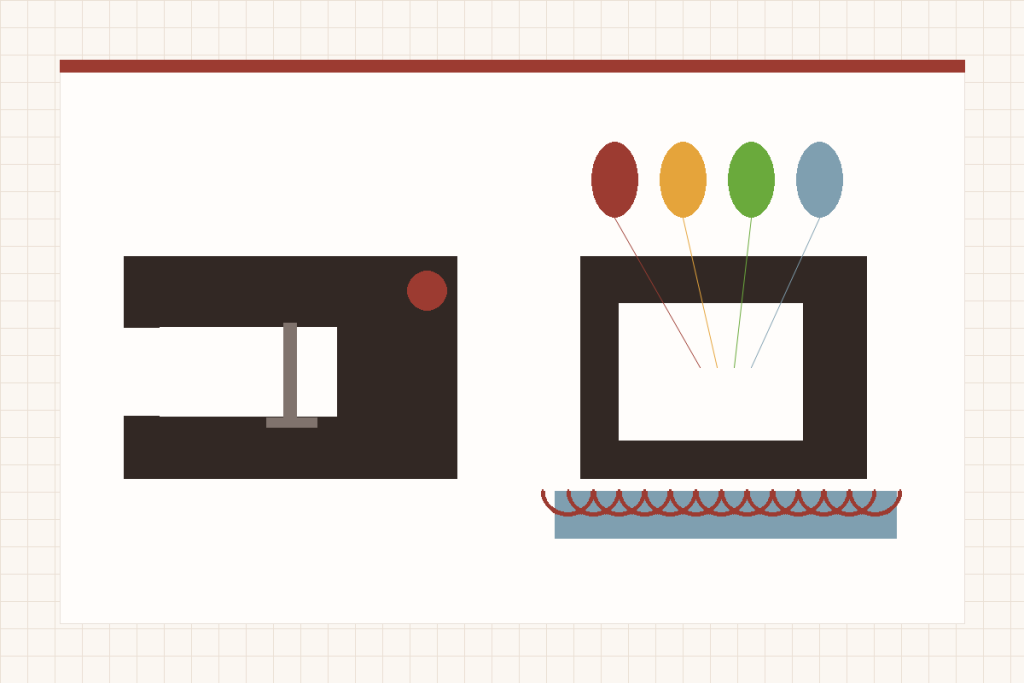
In a serger vs sewing machine decision, the machines overlap on some seams but do different primary jobs. A conventional sewing machine forms lockstitches for construction, topstitching, zippers and buttonholes. A serger—also called an overlock machine—uses loopers and multiple threads to wrap an edge, often trimming it at the same time.
Correct the idea that one replaces the other
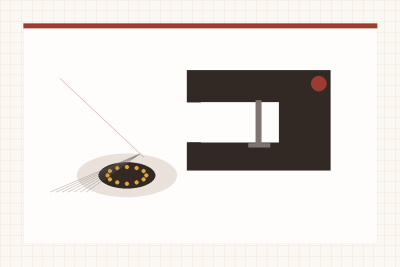
A serger can construct certain seams while finishing the edge, especially on knits. It generally does not replace the straight and zigzag versatility, controlled topstitching, buttonholes, zipper insertion, patching or free-arm tasks of a general sewing machine. Likewise, an ordinary sewing machine can finish edges with zigzag or overcast stitches but does not reproduce every overlock formation.
Exact machines vary. Some sergers form three- and four-thread overlock, rolled hem or flatlock-like arrangements; others add coverstitch capability. Sewing machines vary from straight-stitch-only specialists to broad computerized models. Compare documented stitches rather than assuming every product in a category shares the same formation.
Construction and controlled placement
Lockstitch, zippers, buttonholes, topstitching and broad utility work.
Edge wrapping and simultaneous trimming
Loopers create stretch-friendly overedges and fast seam allowances.
A separate hem formation
Do not assume an overlock serger makes the twin-needle-style cover hem.
See what happens to the fabric edge
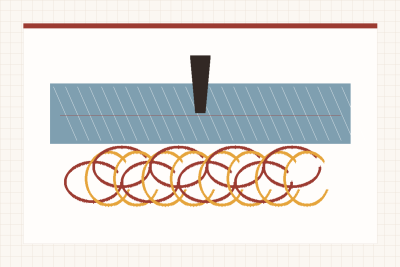
A conventional lockstitch interlocks a needle thread and bobbin thread. It normally does not cut the fabric, so seam allowance remains available for fitting, grading or later alteration. A serger uses needles and loopers to form thread around the edge and commonly uses a knife to trim before formation.
That knife can create a clean consistent edge, but it removes material immediately. Beginners should practice on scrap, confirm cutting-width controls and keep fingers, pins and clips away according to the exact manual. Do not sew over pins near the knife or loopers.
Route common projects to the right machine
| Project job | Primary machine | Reason |
|---|---|---|
| Install a zipper | Sewing machine | Controlled straight stitching and zipper-foot placement. |
| Make buttonholes | Sewing machine | General sergers do not replace buttonhole functions. |
| Topstitch a collar | Sewing machine | The seam must be placed away from a raw edge. |
| Finish woven seam allowances | Either, by different methods | Zigzag/overcast preserves more control; serging trims and wraps quickly. |
| Construct a knit T-shirt side seam | Often serger, with sewing machine still useful | Overlock can stretch and finish in one pass when correctly configured. |
| Rolled edge on suitable lightweight fabric | Serger if documented | A supported rolled-hem conversion can create a narrow wrapped edge. |
| Hem a knit like ready-to-wear coverstitch | Coverstitch or alternative sewing method | A standard overlocker may not form a true coverstitch. |
| Repair inside a narrow sleeve | Sewing machine/free arm or hand method | Serger access and cutting may be inappropriate. |
Knits are the strongest serger argument—but not an automatic one
Overlock formations can stretch with knit fabric and wrap the cut edge in one pass. Differential feed on supported sergers can help manage stretching or gathering by changing the relationship between feed dogs. This does not eliminate the need to test fabric, thread, needles, stitch formation and differential-feed settings.
A sewing machine can still construct knits using a compatible stretch stitch, narrow zigzag or other documented method, plus appropriate needle and foot. It remains useful for neckband preparation, topstitching, hems and details. A beginner who sews occasional knits can learn on one capable sewing machine before adding a four-thread workflow.
Woven garments need both precision and finish
For woven clothing, construction order matters. A sewing machine provides precise seam placement, basting, darts, easing, zippers and buttonholes. A serger can finish allowances before or after construction depending on the pattern. Trimming too early can remove fitting room or notches, so the pattern and technique should decide when the knife is used.
Some sewists construct stable woven seams on a serger, but that does not make it the best route for every curved, fitted or frequently altered garment. Keep the lockstitch machine available for reinforcement, pressing-friendly seam choices and visible topstitching.
Threading and correction have different consequences
A domestic sewing machine usually has one upper thread and one bobbin path. A serger can have several color-coded needle and looper paths with a required threading order. Air threading or needle-threading aids can reduce parts of the process, but they do not remove tension, needle, looper or conversion setup.
- Can you identify every looper and needle path in the exact manual?
- Does the machine support the overlock and rolled-hem formations you need?
- Can differential feed be returned to a known baseline?
- Are the correct needles, thread cones and replacement knives available?
- Is there a local or remote support route for timing and looper strikes?
- Can you test threading and every intended formation during the return period?
A threading error can create looping, breaks or an unformed chain. Restore the exact path and settings rather than turning all tensions at once. A looper strike, knife damage, grinding or seized handwheel is a service boundary.
Compare ownership cost as a two-station system
A serger requires more thread positions, space, lint cleaning and specialized parts. It may save finishing time, but only on projects that use its formations. Include thread cones, needles, spare knives, feet, classes or support and a stable table in the budget. Do not buy based only on maximum speed.
If space allows only one machine, choose the one that completes the most irreplaceable tasks. For most first-time garment sewists, that is a general sewing machine. A serger becomes easier to justify after several projects reveal repeated edge-finishing or knit-seam bottlenecks.
Test the finished seam, not only the machine speed
A fast serger can create a long incorrect seam quickly. Test chain formation, seam stretch, edge coverage, cutting width and fabric behavior on the actual material before assembling the garment. Pull the sample in the direction the finished item will move and inspect whether the seam recovers without popped threads or tunneling. Save the sample with the threading and settings record.
Compare the same project finished on the sewing machine when practical. The serged version may be faster or more flexible, while the sewing-machine method may preserve fitting allowance or give cleaner control around a detail. The purpose of the comparison is not to make the serger win every edge; it is to find where its formation improves repeatable work.
Use three real projects as the purchase test
- List three completed or planned projects. Mark every construction, finishing, hem, zipper, buttonhole and topstitching task.
- Assign each task to a machine. Use exact documented stitch capability, not category assumptions.
- Count the serger-only or serger-better steps. Separate genuine workflow savings from cosmetic interest.
- Check room and support. Plan threading, cleaning, supplies and service for a second station.
- Buy only when the job repeats. A serger is valuable when it removes a recurring bottleneck, not when it merely duplicates edge finishing.
For a broad first-machine shortlist, see the best sewing machines for beginners. The project-backward buying guide maps machine capabilities to finished work without treating one category as universally superior.