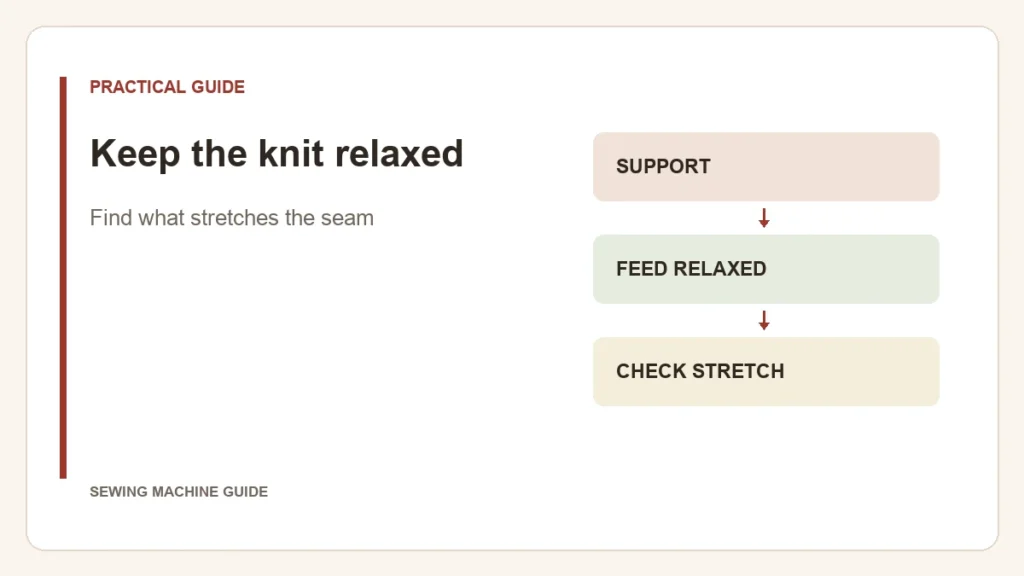
Watch when the knit changes shape. If the edge grows as it passes under the foot, start with feeding and support. If it lies flat but the finished seam breaks when stretched, start with the stitch’s suitability. Those observations lead to different adjustments.
Establish whether the edge is growing
Cut matching scraps in the same direction as the garment seam. Mark their original length and keep an unsewn piece beside them. Support the work at table height, guide it without pulling, and sew the recommended starting setup. Compare the sewn edge against the unsewn reference.
| Observation | Next useful check |
|---|---|
| It stretches while your hands guide it | Remove pulling or resistance from the handling and support the hanging fabric |
| It still lengthens with relaxed handling | Check the exact model’s pressure guidance and permitted feeding accessories |
| It stays flat but the seam cannot stretch with the fabric | Review the recommended stitch type and needle/thread arrangement |
| Stitches are missing or the thread nests | Treat stitch formation as a separate fault before judging the appearance |
Pressure adjustment belongs to the model
The Janome 9410QC manual provides fabric-related pressure and stitch guidance. Use your own machine’s instructions for the equivalent controls. A fixed-pressure machine does not become adjustable by turning an internal spring screw.
If the manual permits an adjustment, make one change and label the resulting sample. Keep needle system and point appropriate to the knit; do not let a pressure experiment hide a damaged or unsuitable needle. The pressure-versus-tension distinction is useful when the stitches look balanced but the fabric does not.
Judge the seam as the garment will use it
Inspect both faces, then gently stretch the sample as required by the garment. A flat edge that immediately pops its stitches is not a finished solution. Equally, a seam with balanced stitches may still have been stretched during feeding.
A compatible walking foot can help layers advance together on some projects, but it is not an adjustable differential-feed system. If the machine in front of you is a serger, use its differential-feed diagnosis instead of transferring conventional-machine settings.