Bernette B08 Review: Straight-Stitch Speed With a Narrow Purpose
At a Glance
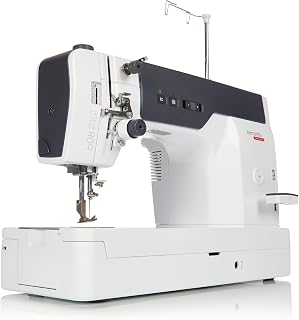
KEY FEATURES
- Dedicated straight stitch at up to 1,600 stitches per minute
- Speed slider and needle-stop control
- 225 mm workspace to the right of the needle
- Large side-loading bobbin and independent winding motor
- 60 × 40 cm extension table included
PROS
- One owner describes smooth, quiet sewing and easy initial setup
- That owner reports useful results through cork and thicker layered work
- The positive account says the machine made repetitive work faster
CONS
- Another owner considered straight-stitch-only capability poor value
- The two-review sample cannot establish a reliability pattern
- Customer feedback does not cover buttonholes, knits or general-purpose use
Editorial Rating
Based on supplied customer reviews and verified product documentation
Price and availability subject to change
The Bernette B08 is not trying to be a versatile household machine. It removes zigzag, buttonholes and decorative stitches to concentrate on one operation at up to 1,600 stitches per minute. That makes the B08 unusually clear to assess: the same specialization that speeds up long straight-seam work can make it the wrong only machine.
One stitch is the design, not an omission
A dedicated straight-stitch plate and configuration support clean fabric control around the needle. The maximum stitch length reaches 6 mm, reverse has a direct lever, and presser-foot pressure is adjustable. Those controls matter for topstitching, piecing and repeated seams where the operator wants fewer layers of menus or stitch-selection decisions.
The trade is categorical. There is no zigzag for raw-edge finishing, stretch stitch for knit construction, decorative menu or automatic buttonhole. The machine can be an efficient partner to an overlocker or a multi-stitch domestic model; it is far less convincing as the only machine in a general garment workspace.
Where 1,600 stitches per minute changes the workflow
Maximum speed attracts attention, but the slide speed control is the more important specification. It lets the operator set a lower ceiling for corners, starts and detailed work rather than relying only on foot pressure. Needle stop up/down and a knee lifter further reduce the need to move hands away from the work when pivoting or repositioning.
The large bobbin is built for long runs
Bernette says the side-loading bobbin holds about 40% more thread than a standard bobbin. A separate bobbin-winding motor means winding is not tied to the main needle drive. Together, those features reduce interruptions during repeated long seams, even though they do not themselves improve stitch quality.
Size and weight make this a workstation machine
The B08 weighs 14.6 kg and provides 225 mm to the right of the needle. Bernette also includes a 60 × 40 cm extension table. That combination supports a stable, broad work surface but makes the machine an awkward candidate for weekly classes or frequent storage.
The two-owner sample pulls in opposite directions
One collected owner text describes smooth, quiet operation, simple out-of-box setup and useful performance through cork or thick layered work. That is one person’s project report, not a published material rating. The other text argues that a straight-stitch-only machine does not justify its value.
Neither comment can establish a pattern from a two-text sample. Together they reveal the central buying split accurately: an owner with repeat straight-seam work sees efficiency, while a shopper expecting general-purpose stitch variety sees a costly limitation.
Focused work became faster
One owner describes easy setup, smooth and quiet running, and useful results with cork and layered projects.
One stitch felt too limiting
The other owner considered the value weak because the machine cannot move beyond straight stitch.
Quilting capacity needs accessory context
The workspace, extension table, knee lift, straight stitch and feed-dog cover plate are all relevant to quilting. The cover plate enables a free-motion setup without a retractable feed mechanism. However, a walking foot and quarter-inch foot are not confirmed in the standard two-foot package, so they should be budgeted and compatibility-checked rather than assumed.
The generous harp is helpful, but it is not a longarm. The weight and table need a permanent, level surface, and large quilts still require support so their mass does not pull against the needle.
Choose the B08 only if the narrow purpose is the benefit
The strongest case is a sewist who does extensive piecing, bags, straight-seam production or topstitching and already has another way to make zigzag, buttonholes and stretch seams. For that buyer, speed limiting, a large bobbin and hands-free presser-foot lift are workflow features rather than specification decoration.
If you are still discovering the kinds of sewing you enjoy, a capable computerized or mechanical domestic machine will leave more paths open. The B08 rewards a settled workflow, not a broad wish list.
- List your last five projects: if they required zigzag, knits or buttonholes, the B08 cannot be your only machine.
- Plan the workstation: allow permanent space for the 14.6 kg machine and extension table.
- Price the missing feet: confirm walking-foot and quarter-inch-foot compatibility separately.
Pros & Cons Analysis
Based on supplied customer reviews and verified product documentation
Pros
- One collected owner says the B08 was straightforward to set up and ran smoothly and quietly.
- The same owner reports successful work with cork and layered materials, while recognizing that this is one project account rather than a material rating.
- That positive account describes a meaningful workflow improvement for repeated straight-seam work.
Cons
- The other collected owner rejected the value proposition because the machine makes only a straight stitch.
- With only two supplied review texts, there is no customer consensus on durability, service or long-term tension consistency.
- The owner sample does not establish performance for the broad garment tasks a multi-stitch machine would cover.
Our Verdict
Bottom line
The B08 makes sense when straight stitch is the whole workflow—not merely one stitch you use sometimes.
Its strongest customer account describes smooth, quiet operation, simple setup and faster work through cork and layered projects. The opposing account sees the single-stitch limitation as poor value. That split is the purchase decision in miniature.
Choose the B08 for
- Repeated piecing, topstitching and long straight seams.
- A permanent workstation where its weight and extension table are advantages.
- A sewing room that already has another solution for zigzag, knits and buttonholes.
Choose a domestic multi-stitch machine instead if
- This will be your only machine.
- You regularly construct knit garments or finish raw edges with zigzag.
- You value broad stitch choice more than production-style straight-seam efficiency.
What the score can and cannot tell you
The published controls make the B08 technically compelling, but two owner texts cannot establish long-term tension consistency, service quality or durability. The positive account supports the workflow case; the negative one confirms that specialization can feel like poor value. Treat the rating as a structured purchase assessment and test your usual thread, needle and layered seam during the return period.
Frequently Asked Questions
Does the Bernette B08 sew zigzag or buttonholes?
No. It is a dedicated straight-stitch machine; the limitation is central to the design.
How fast is the B08?
Bernette publishes a maximum of 1,600 stitches per minute and provides a speed slider so the upper limit can be reduced.
Is an extension table included?
Yes. Bernette lists a 60 × 40 cm extension table among the standard accessories.
Can it be used for quilting?
Its straight stitch, 225 mm workspace, extension table, drop-feed cover plate and knee lifter are relevant to piecing and quilting. Confirm any specialty feet separately.
What do customers say about the B08?
The supplied sample contains two opposing accounts. One owner reports smooth, quiet sewing and faster work through cork and layers; the other sees straight-stitch-only capability as poor value. That is useful context, not a reliability consensus.
Technical Specifications
| Machine class | Full-size dedicated straight-stitch machine |
|---|---|
| Control type | Electronic motor controls with mechanical stitch adjustment |
| Primary functions | Straight sewing, piecing, topstitching and long seams |
| Built-in stitches / applications | 1 straight stitch |
| Maximum sewing speed | 1,600 stitches per minute |
| Speed control | Yes — slide speed control |
| Maximum stitch length | 6 mm |
| Maximum stitch width | Not applicable — fixed straight stitch |
| Needle stop up/down | Yes |
| Bobbin / looper system | Rotary hook with side-loading extra-large bobbin |
| Workspace right of needle | 225 mm |
| Included presser feet | 2 |
| Quilting stitches | 1 straight stitch for piecing and quilting |
| Needle threader | Semi-automatic |
| Feed-dog control | Cover plate supplied for free-motion work |
Janome 8200QCP Special Edition Review: 11-Inch Quilting Space With Real Weight
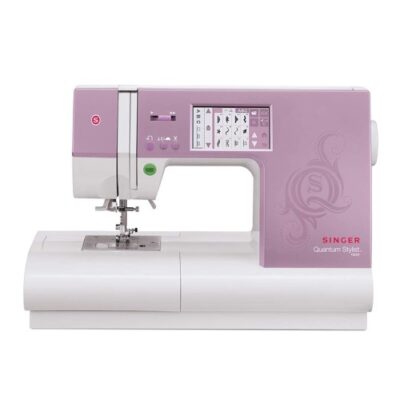
Singer 9985 Review: Color-Touchscreen Depth With Setup-Sensitive Automation
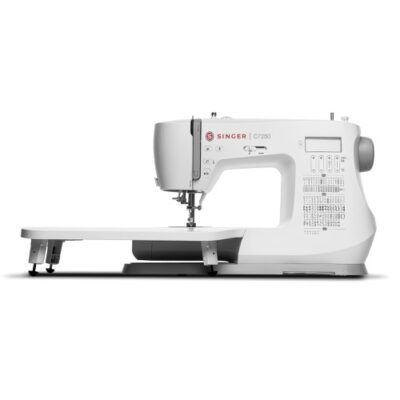
Singer C7250 Review: Practical Quilting Controls With Cutter Concerns