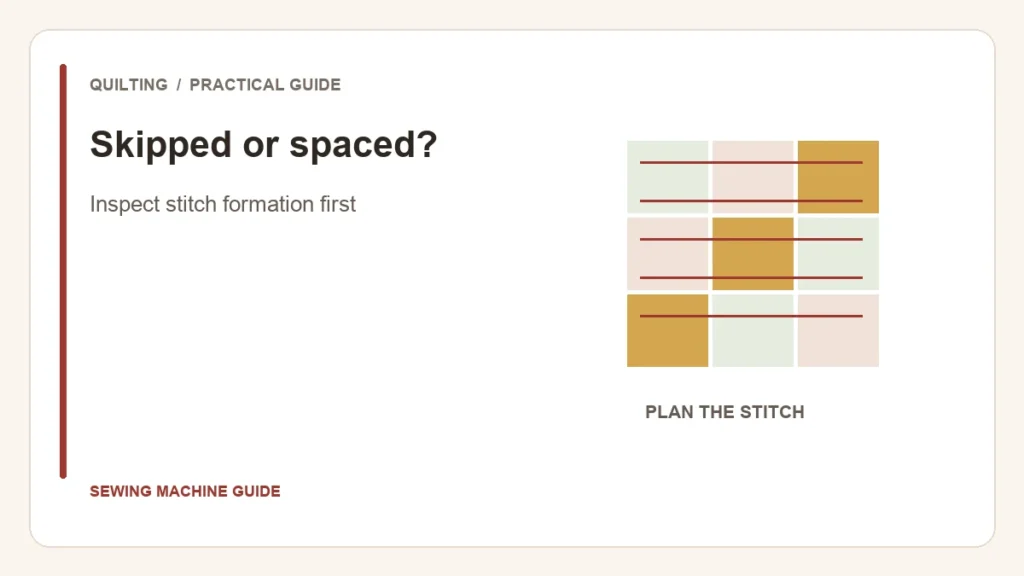
A long space between stitches is not always a skipped stitch. With unregulated free motion, moving the fabric quickly can make widely spaced stitches. A true skip means a penetration failed to form the expected stitch. Examine the sample before changing tension.
Uneven spacing
Compare hand movement with sewing speed.
Missing stitch formation
Check the approved needle, threading and free-motion setup.
Needle strike or hard stop
Stop sewing and resolve the mechanical contact.
Establish a known setup
Confirm the exact free-motion foot, permitted feed arrangement and needle system from your manual. Some machines provide a free-motion mode or adjustable foot height; those features cannot be assumed from a feed-dog lever alone.
Brother’s EV1 instructions explicitly connect fabric movement with sewing speed and use model-specific free-motion feet and height control. That is evidence for the EV1 procedure, not a universal height setting.
Use two samples to narrow the question
- Inspect and replace an unsuitable or damaged needle using the exact instructions. Recheck upper and bobbin threading.
- With a supported ordinary sewing setup, stitch a stable scrap to see whether the machine forms consistent stitches outside free motion.
- Return to the complete approved free-motion setup and sew a simple path on the intended sandwich.
- Record whether the issue occurs in every direction, only on turns or only when the sandwich catches.
- Keep the samples and settings so the difference can be explained to support.
A good ordinary seam does not certify every free-motion component. It gives you a useful distinction: the problem may depend on the special setup, fabric movement or sandwich. A poor ordinary seam means the fault is broader than learning to draw a quilting motif.
Check fabric movement without forcing it
Support the work so it does not hang from the needle area. Watch whether it moves freely under the approved foot. If a model allows height adjustment, follow its procedure rather than turning a random screw. Janome’s Continental M7 manual addresses its adjustable free-motion arrangement; another foot may have no equivalent adjustment.
End the test when the evidence stops improving
If the documented setup and a fresh correct needle still produce repeated skips, stop experimenting and provide the machine model, foot part number and samples to support. Do not compensate by pulling harder or altering timing. If the stitches form but spacing varies, return to a simple path and practice coordinating movement at a comfortable supported speed.