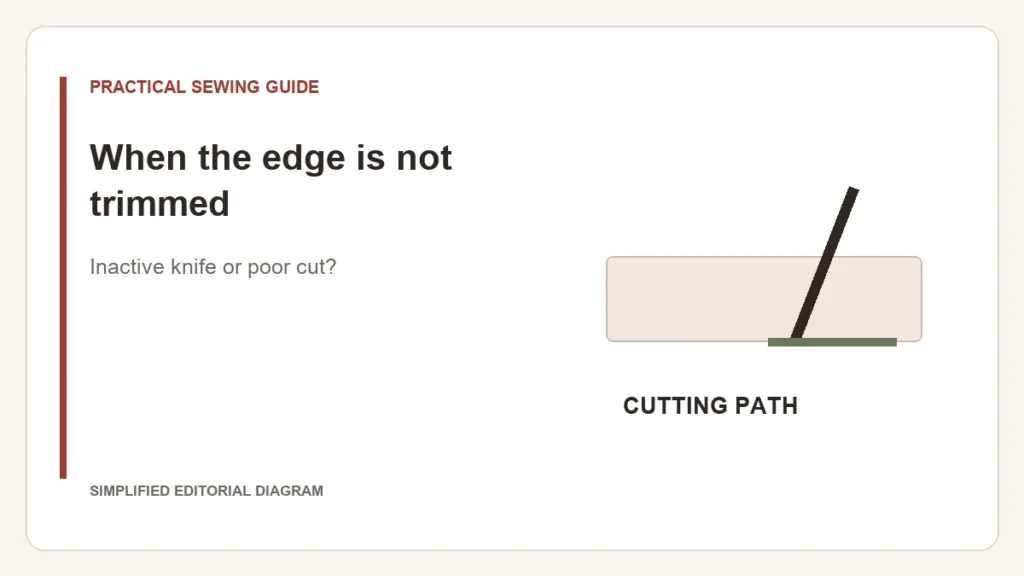
Stop and inspect the result before adjusting thread tension. A serger can form stitches while failing to trim properly. A completely uncut allowance and a chewed edge point to different questions, and neither is fixed simply by tightening the loopers.
Brother’s knife troubleshooting page distinguishes a locked knife from worn blades and directs replacement to an authorized dealer. That is a useful limit: a general guide should not turn a poor cut into an invitation to alter blade alignment.
Bring a useful sample to support
- Keep a sample showing the uncut or ragged edge.
- Record the exact model, stitch configuration and material layers.
- Note whether the issue began after a knife change, a jam or a change of stitch setup.
- Report unusual contact or noise rather than repeatedly running the machine to reproduce it.
Remove pins and clips before the cutting area. Do not use fingers to guide scraps close to the knife, sharpen it in place, or continue through abnormal resistance.
When trimming is clean but loops extend beyond the edge, the next question is cutting width relative to stitch formation. When trimming itself is poor, resolve that first; a different thread tension will not restore a damaged cutting edge.