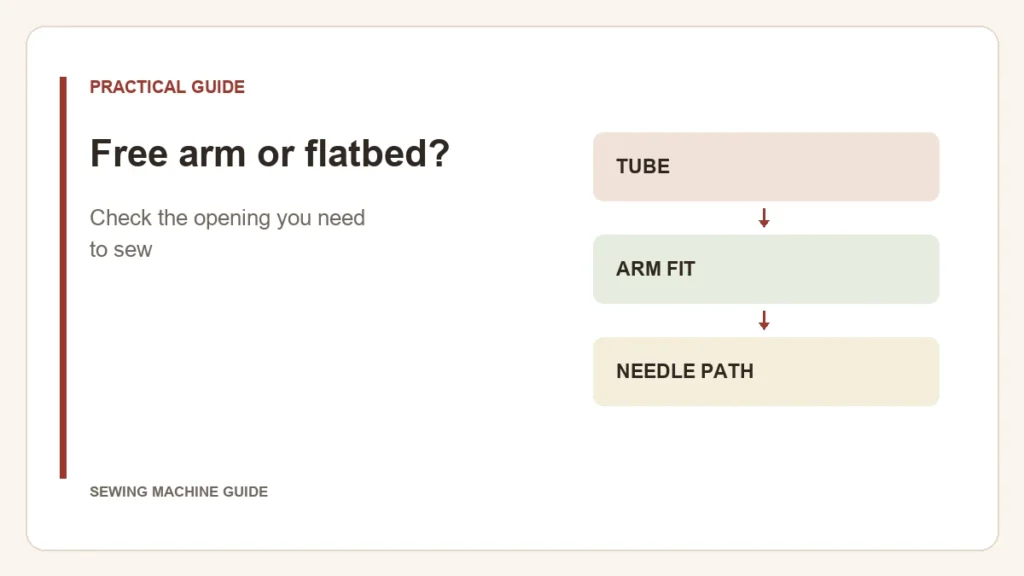
A free arm is useful when a finished sleeve or trouser leg can slide over the narrow bed. A flatbed is useful when the fabric can lie open and needs support. The stage of construction often decides which arrangement helps more than the size of the machine does.
Follow one cuff through the sewing process
Before the sleeve is joined: the cuff edge is a flat piece. You can support it on the machine bed, provided the pattern allows the hem to be sewn at that stage. There is no tube to place around an arm yet.
After the sleeve is joined: the same edge is a ring. A free arm can keep the underside of that ring away from the needle while you sew around it. It only helps if the opening fits without being stretched.
During a later alteration: the construction is already fixed. Check the smallest opening at the actual hem line, not the wider raw edge. An adult trouser leg fitting over the arm says little about a narrow child’s cuff.
What happens when the tube is too small?
Do not pull a knit cuff over an arm that is too large. You still need a way to present one layer at a time and keep the opposite side clear. A different construction order may be possible on a new garment; an existing garment needs careful positioning or an alternative finishing method. The free-arm label alone does not solve that access problem.
| Work in front of you | Useful bed arrangement | What to inspect |
|---|---|---|
| Open sleeve or long seam | Flat surface | Fabric supported rather than hanging from the needle area |
| Finished tube that fits | Exposed free arm | The stitching line can reach the needle without stretching |
| Large quilt | Broad support plus adequate throat space | The bulk can move; removing a compartment does not create more throat room |
Removing a table is not proof of a free arm
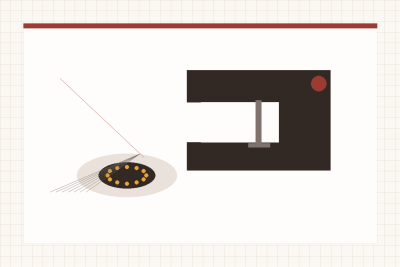
Brother’s free-arm instructions for the CP100X and listed related models show a removable compartment exposing the narrow arm. A dedicated straight-stitch machine may remain a flatbed when its extension table comes off. Look at the model diagram, not just an accessory-table photograph.
For alterations, bring your smallest finished opening to a demonstration. For large flat projects, assess throat space and external support separately. Choose the arrangement that makes the difficult part of your project accessible.