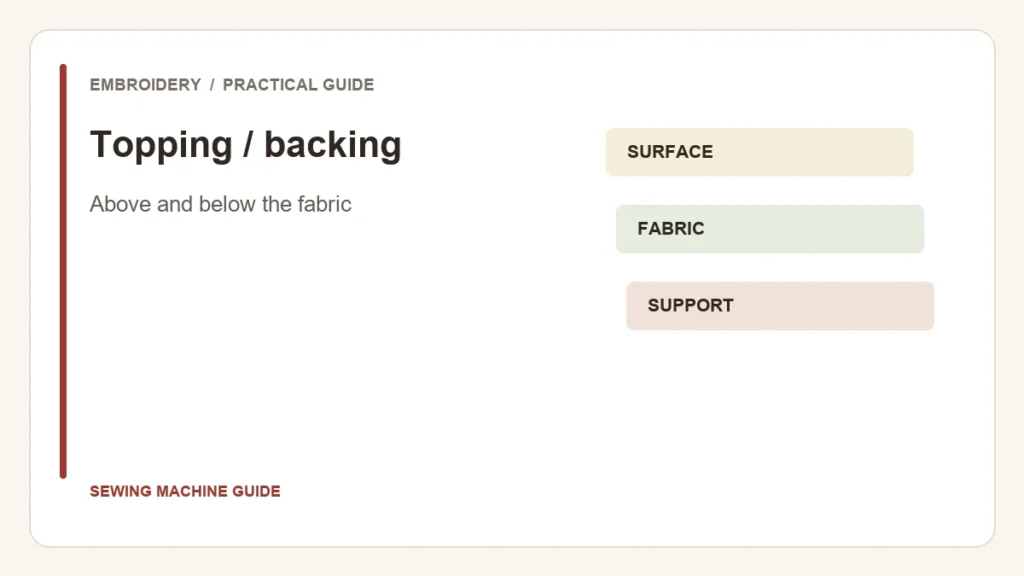
“Water-soluble” describes removal, not where a product belongs. A topping sits above the fabric to help stitches remain visible on a textured surface. A wash-away backing supports the work from below. One label does not make the products interchangeable.
Above the fabric
Topping helps keep embroidery from sinking into a textured surface.
Below the fabric
Backing supports the fabric or a design intended to stand without fabric.
Ask what needs supporting
A towel presents two separate questions: how the cloth stays stable while stitching, and how a small letter remains visible above its loops. A surface film can address the second without establishing that the first is solved. Treat backing and topping as separate choices in the setup.
Sulky’s water-soluble stabilizer guidance identifies light Solvy as a topping for napped fabrics and describes different types and weights. Read the particular product’s description for whether it is a topping, backing or another specialty material.
| Planned result | What to establish before stitching |
|---|---|
| Lettering on textured fabric | A compatible topping and an independently suitable backing. |
| Freestanding lace | A design digitized for that method and its specified support/removal process. |
| Embroidery on a water-sensitive item | A permitted stabilization method that does not require unsuitable wet removal. |
| A soft finished garment | How much support remains after excess material is removed. |
Removal belongs in the project plan
Do not wait until the design is finished to discover that the stabilizer needs soaking. Singer’s stabilizer explanation includes product-specific water-removal directions. Water temperature and exposure time belong to that product; they are not safe assumptions for every film, fabric or garment.
- Read the stabilizer label and the fabric or garment care instructions together.
- Reject a combination whose required removal would conflict with the finished item’s care.
- Test on a representative sample, including the backing, topping and design.
- Remove the material as instructed and let the sample finish drying before judging stiffness or residue.
- Inspect whether small details remain legible and whether the embroidery keeps its intended shape.
Choose by position and purpose
Label supplies with their intended position as well as their removal type. For backing that remains or tears away, compare cut-away and tear-away. For a textured surface, test the extra topping layer without assuming it replaces the rest of the setup.