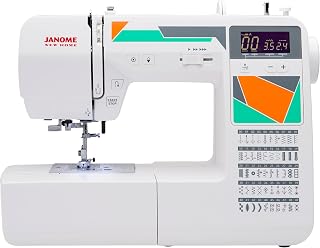
Juki HZL-HT740 Review: Useful Sewing Controls, Modest Lettering
At a Glance

KEY FEATURES
- 116 stitch patterns plus two alphanumeric fonts
- Automatic trimming and needle-position controls
- Adjustable foot pressure
- Optional wide table; soft cover listed as standard
PROS
- Trimming and needle control help repeated sewing tasks
- Speed control is useful for a learner setting a manageable pace
- Ordinary stitch results are praised in the small sample
- Letter patterns add modest personalization without a separate embroidery setup
CONS
- Only three substantive supplied accounts
- Wide table is an extra rather than a standard inclusion
- One owner found lettering too small for their needs
- A retained account reports difficulty with heavier material
Editorial Rating
Based on supplied customer reviews and verified product documentation
Price and availability subject to change
The Juki HZL-HT740 deserves attention for its everyday sewing controls before its lettering. Automatic trimming, needle positioning and adjustable speed can matter on nearly every project. A large advertised pattern total matters much less if the letters are too small for the labels or decoration you have in mind.
Three useful accounts, rather than a broad consensus
Only four texts were supplied for this listing, and one contains little more than general praise. The three substantive accounts describe good ordinary stitches and useful controls. A beginner particularly appreciated the pace control and bobbin setup. Another owner liked it for classes or backup use. These are encouraging experiences, but too few to establish a reliability record.
The most detailed account is also the most qualified: the owner liked the stitches, buttonholes, threader and trimmer, but found aspects of the instructions unclear, wanted more accessories and had difficulty with heavier material. We retain those reservations. The Juki name alone does not make every domestic model a substitute for a heavier sewing specialist.
Routine sewing controls
All three substantive accounts favor ordinary sewing results or conveniences. One beginner especially appreciated pace control and bobbin setup.
Check instructions and heavy seams
The most detailed owner liked the trimmer, threader and buttonholes but wanted clearer instructions and reported difficulty with heavier material.
Lettering has a specific, limited role
Juki lists 116 stitch patterns and two alphanumeric fonts. These letters are sewn as the fabric feeds under the foot; they are not uploaded designs stitched by a moving embroidery hoop.
One retained owner found the letters too small. We have no independently verified letter-height measurement, so that observation is a reason to inspect the result rather than publish an estimated size.
Budget for the working surface you actually need
| Included in Juki’s standard inventory | Requires a separate offer check |
|---|---|
| Seven presser feet and a soft cover | A wide extension table is listed as optional. |
| Automatic trimming and adjustable speed | A seller photograph may show a table that is outside the base package. |
| 165 mm arm space in the specification | An external table supports cloth; it does not enlarge that internal opening. |
Two of the three substantive accounts mention wanting a table. The HT740 manufacturer inventory resolves this as a package-budget issue. Include the optional surface in your comparison if it is necessary for the work you plan.
How to judge the HT740 for your own work
A useful demonstration should include a short straight seam at low speed, a buttonhole and the seam crossing you repeat most often. Then try the cutter and needle-position controls without help. This makes it easier to tell whether the convenience features improve your work or merely add buttons you seldom use.
For ordinary garments, classes and mixed household projects, the documented feature set is a plausible fit. For specialized heavy construction or large-format embroidery, it is the wrong basis for choosing a machine. Compare it with the computerized shortlist, and use our mechanical versus computerized guide to decide which controls justify changing from your current machine.
Customer photos
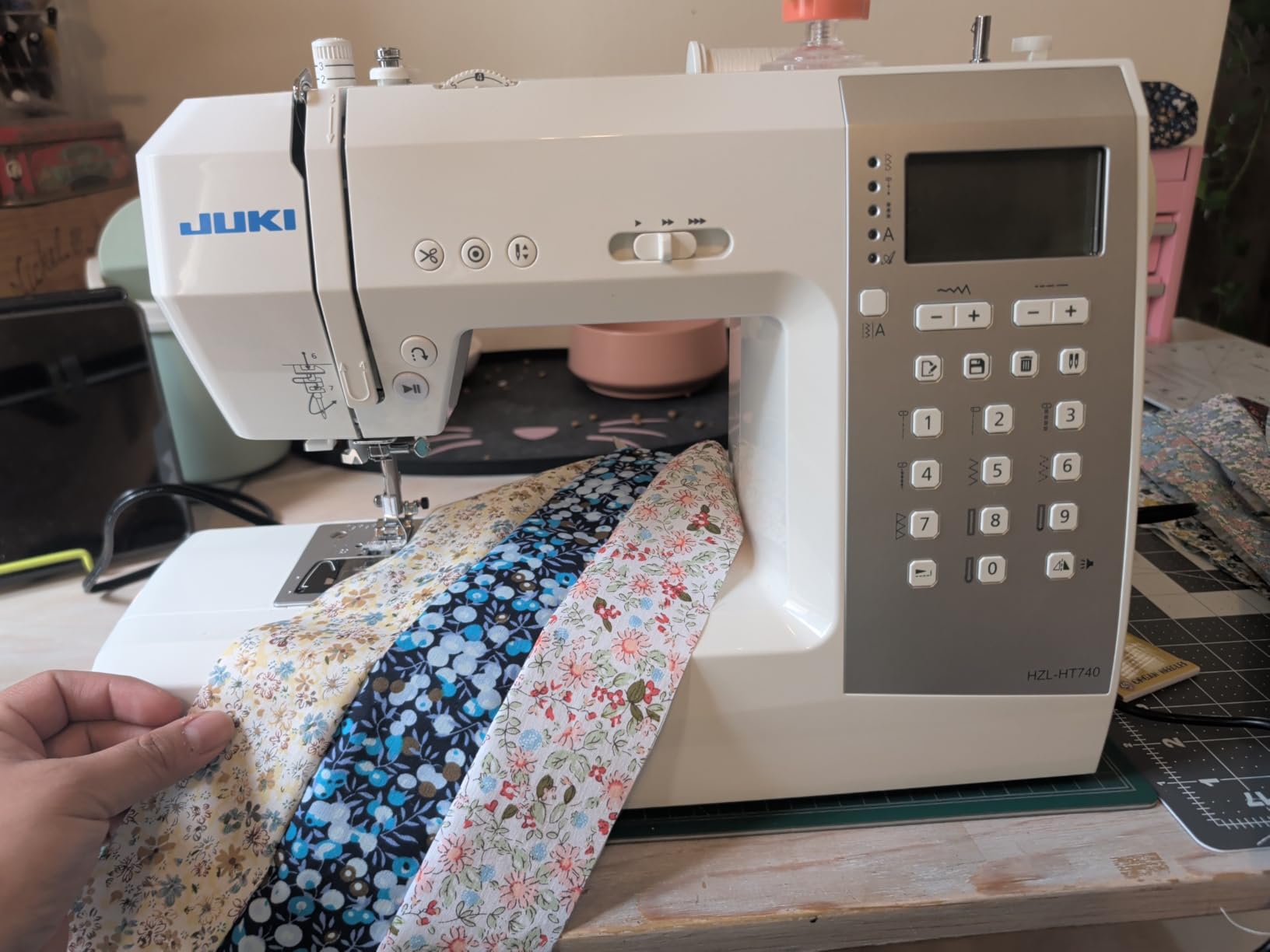
Pros & Cons Analysis
Based on supplied customer reviews and verified product documentation
Pros
- Useful controls throughout a project. Owners appreciate trimming and needle-related conveniences, including pedal or button operation. These address repeated actions rather than a feature used only occasionally.
- A pace a learner can choose. A beginner valued speed management and bobbin setup. The documented slider offers control, although one short ownership account cannot establish universal ease of use.
- Ordinary sewing drew favorable comments. All three retained accounts praise results or everyday operation; even the most critical liked stitches and buttonholes. This remains a very small sample.
- Lettering can add a modest extra. Two built-in fonts may suit small labels or personalization. An owner found them too small, so inspect a sewn sample before relying on that benefit.
Cons
- The table changes the package budget. Two owners wanted an extension table. Juki lists it as optional, so include its cost unless the seller explicitly bundles it.
- Some functions need clearer guidance. The detailed account wanted better explanations of patterns, feet and less familiar techniques. Model-specific instruction may be necessary to use the available features confidently.
- An alphabet may not fit your project. The lettering complaint concerns usable size, not ordinary seam quality. Font count cannot establish whether a finished label will be readable enough.
- Heavy-work evidence is limited. One of three substantive accounts struggled with heavier outdoor fabric. Do not transfer expectations from Juki’s separate TL or industrial machines to this domestic model.
Our Verdict
The HT740 makes its strongest case through everyday sewing conveniences: controlled speed, needle positioning and automatic trimming. I would treat its lettering as an extra rather than the main reason to buy.
Price the working setup, then try the letters
The three substantive accounts are encouraging about ordinary stitches, but too limited for a confident long-term verdict. For garments, classes or backup use, the control set is plausible. A buyer attracted primarily by personalization needs to see the actual sewn font; built-in alphabets are not an uploaded-design embroidery system.
Add the optional table to the offer comparison if your projects need it. If the intended work is predominantly bulky construction or large embroidery, choose around that requirement instead of letting the Juki name or pattern total settle the decision.
Frequently Asked Questions
Does the HT740 come with a wide table?
Juki lists the wide table as optional. A seller bundle may add it, but verify the exact offer.
Can it embroider uploaded designs?
Its documented lettering is made with built-in stitch patterns. It is not a hoop-embroidery system for uploaded designs.
Does it have a knee lifter or micro-lift?
Neither feature is listed for the HZL-HT740. Do not transfer features from Juki’s TL or higher-end ranges.
What does the stitch count mean?
Juki specifies 116 patterns and two alphanumeric fonts. A larger listing total may count letters and symbols separately.
Technical Specifications
| Machine class | Computerized domestic sewing machine |
|---|---|
| Control type | Buttons and LCD |
| Primary functions | Domestic sewing, stitch patterns and built-in lettering |
| Built-in stitches / applications | 116 patterns plus two alphanumeric fonts |
| Maximum sewing speed | 800 stitches per minute |
| Speed control | Slider, pedal and start/stop |
| Maximum stitch length | 4.5 mm |
| Maximum stitch width | 7 mm |
| Needle stop up/down | Button selection |
| Needle threader | Built-in assisted threader |
| Thread cutter | Automatic |
| Bobbin / looper system | Horizontal hook; drop-in bobbin |
Bernette B77 Review: Premium Control With a Real Learning Curve
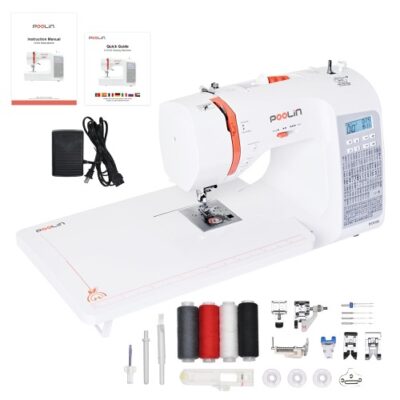
PooLin EOC02 Review: Beginner-Friendly Controls With Thick-Layer Limits
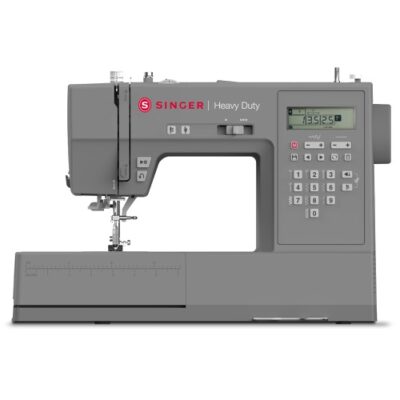
Singer 6700C Review: Fast Computerized Control With Heavy-Duty Limits