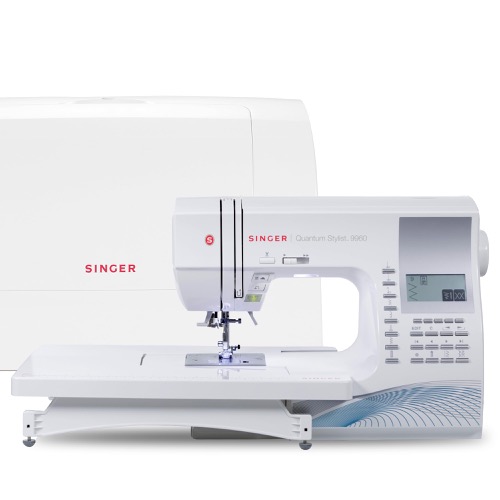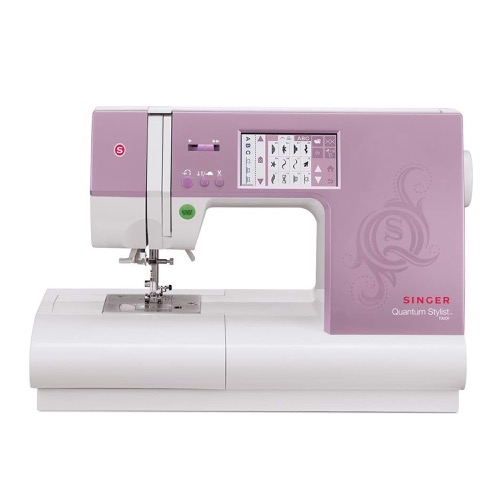
Singer 9960 vs 9985 is mainly a question of how much interface and decorative control you will use. The 9960 is the stronger value for most mixed garment and moderate-quilting work because it already supplies speed limiting, needle stop, automatic trimming, 600 stitches and a coherent foot-and-table bundle. The 9985 earns its premium when a color touchscreen, six alphabets, greater stitch depth and adjustable presser-foot pressure will enter the weekly workflow.
The shared foundation makes this a feature-use decision
Both Quantum Stylist machines are full-size computerized domestic models with a top-loading Class 15 bobbin, free arm, drop feed, start/stop sewing, electronic speed limiting and an automatic thread cutter. Singer publishes a maximum sewing speed of 850 stitches per minute for both. Each includes an extension table and quilting-oriented feet, so neither wins merely by appearing more suitable for patchwork.
The two records also identify similar physical boundaries. The 9960 has about 6.4 inches to the right of the needle and the 9985 about 6.6 inches. That difference is too small to turn either machine into a wide-throat quilting specialist. A table supports fabric outside the machine, but it cannot create internal clearance for a large quilt roll.
The 9985 pays for navigation and personalization depth
The 9960 uses an LCD and direct buttons to select and edit its large library. It includes five alphabets and supports functions such as mirror imaging and elongation on compatible patterns. That is substantial creative range, but browsing hundreds of options on a conventional display asks the operator to work from stitch charts and numeric references.
The 9985 moves selection to a color touchscreen, expands the library to 960 built-in stitches and supplies six alphabets plus sequence memory. The screen can reduce the friction of previewing and organizing decorative choices. It does not improve a straight seam by itself, and a buyer who rarely letters or combines patterns may spend more for an interface that remains mostly idle.
More capability per dollar
Its LCD, five alphabets and 600 stitches already cover broad garment, craft and decorative work.
A clearer creative workspace
The color screen and deeper library suit frequent personalization and sequence building.
Complexity still requires practice
More guided selection does not remove threading, bobbin, tension or stitch-restriction rules.
Adjustable presser-foot pressure is the most practical 9985 distinction
The 9985 documents adjustable presser-foot pressure, while the 9960 uses automatic pressure without a normal user adjustment. That gives the 9985 operator another tool when moving among lightweight cloth, ordinary garment fabrics and layers that feed differently. It is a meaningful control for an experienced sewist who understands why a material is creeping or marking.
Pressure adjustment is not a promise of industrial capacity. Neither machine has compound feed, and both remain domestic platforms. Their included walking feet can help layers travel together, yet the accessory does not enlarge the motor duty cycle or internal opening. Test the exact seam intersection rather than relying on a general “heavy fabric” label.
| Your recurring work | Better fit | Why |
|---|---|---|
| Garments, repairs and moderate quilting | 9960 | The shared core controls and included quilting tools cover the job at the lower feature tier. |
| Frequent lettering and decorative sequences | 9985 | The color screen, sixth alphabet and expanded library reduce selection friction. |
| Fabrics that benefit from manual pressure changes | 9985 | Adjustable presser-foot pressure adds a control the 9960 does not normally expose. |
| Large rolled quilts | Neither | Both provide only about 6.5 inches of right-side workspace. |
Owner reports do not justify assuming the premium model is safer
The supplied evidence contains 100 exact-product owner texts for each machine. Many 9960 owners describe years of smooth sewing, attractive results and useful quilting or decorative range. Negative accounts identify thread nesting, tension trouble, cutter faults, feed problems and units that required repair or return. That pattern supports a full systems check instead of a blanket reliability claim.
Positive 9985 reports emphasize quiet operation, the feeling of a substantial upgrade and easier access to creative functions. Its negative reports include pedal trouble, poor buttonholes, thread jams, cutter problems and damaged or incomplete arrivals. The two equal-sized files are not controlled samples, so counting complaints does not establish a statistically defensible winner. They do identify what each buyer should test.
Does a color touchscreen make the 9985 easier for every beginner?
No. It can make pattern selection clearer, but the larger feature set also creates more functions to learn. A beginner focused on seams, hems and occasional quilting may find the 9960 more than sufficient, while another beginner with a defined personalization plan may value the screen immediately.
Compare the delivered bundle, not remembered accessory counts
Both machines are commonly sold with extension tables and broad foot sets, including garment, decorative and quilting roles. Package descriptions can change by seller or promotion. Confirm the exact feet, cover, needles, bobbins and power accessories shown in the listing you are buying. Give value only to tools that would otherwise be purchased.
The 9960 has the clearer value case when its documented 13-foot core package meets the planned work. The 9985 should not win because a retailer photo appears fuller; its durable advantages are the color interface, decorative depth and adjustable pressure. If those do not change a project, the 9960 leaves less paid capability unused.
Storage should enter the same calculation. The 9960 is published at about 18.2 pounds and the 9985 at about 20 pounds, before the table, pedal and accessory box are added. Neither is an especially small class machine. A permanent table makes the extra controls easier to use, while repeated unpacking can turn a theoretically capable model into one that stays in its case. Measure the intended shelf and work surface, then include the table’s footprint rather than comparing only the machine bodies.
Also compare how each machine will be operated. Both support foot-control and start/stop sewing, so the core choice is not pedal operation versus button operation. The practical question is whether the 9985 screen and pressure setting reduce repeated selection or fabric-adjustment work enough to matter. If you cannot identify that recurring step, treat the 9960 as the baseline and pay more only after comparing the exact delivered bundles and seller return terms.
Use the return period to test the differentiators
- Inventory the exact package. Verify the table, feet, cover, pedal and power equipment against the seller record.
- Prove basic stitch formation. Wind two bobbins and repeat straight, zigzag and stretch seams at low and medium speed.
- Exercise the automation. Test needle stop, reverse, tie-off, start/stop and automatic trimming repeatedly.
- Make complete buttonholes. Use stabilized project fabric rather than a single easy sample.
- Test the reason for paying more. On the 9985, build a saved decorative or lettering sequence and adjust pressure on two contrasting fabrics.
- Run a realistic quilting sandwich. Use the walking foot and manage the largest roll you expect to place through the throat.
Read the Singer 9960 review for its accessory-and-workspace tradeoffs and the Singer 9985 review for its touchscreen and acceptance-test details. You can also compare the broader computerized shortlist or browse computerized sewing machines.