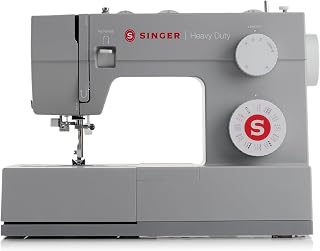
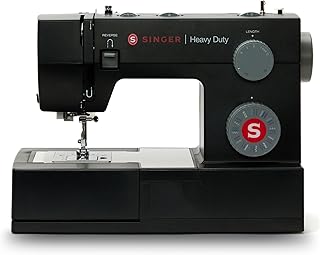
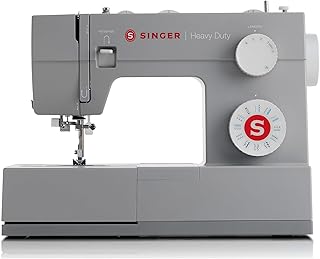
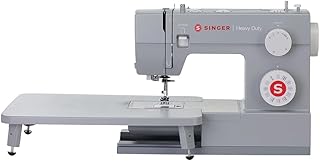
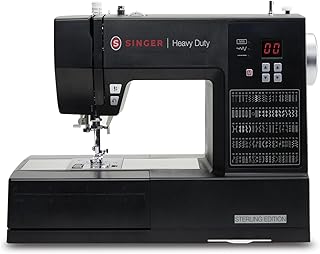
The best Singer heavy duty sewing machine for most home workshops in this group is the 4452, chiefly because its walking foot, non-stick foot, heavy needles and clearance plate address the layered seams buyers usually have in mind. The 4432 offers the same 32-stitch mechanical core with fewer specialized tools, while the lower-cost 4423 is the more rational choice for ordinary hems, repairs and home décor.
These are fast domestic machines, not industrial walking-foot machines. All five can be useful, but the Heavy Duty name does not prove sustained leather, canvas or upholstery production. Fabric stack height, needle choice, feeding method and low-speed pedal control decide more than the gray or black casing.
What “Heavy Duty” means in this Singer range
The mechanical 4423, 4432, 4452 and 6380 share a 1,100-stitch-per-minute published ceiling, adjustable presser-foot pressure and a top drop-in Class 15 bobbin. The 6600C also reaches a published 1,100 spm, but it replaces direct stitch dials with computerized selection, needle-stop control and a much broader application menu.
We used Singer documentation, the normalized exact-model records and the supplied Amazon owner-review files. The site did not physically test these machines, and the review pools cannot establish failure rates. They do show recurring setup and ownership patterns that are useful when two models look nearly identical on a retailer page.
The accessory package creates the clearest separation
The 4452 earns the lead because its even-feed foot helps move layers together, the non-stick foot reduces drag on coated surfaces, and the clearance plate helps the presser foot approach a seam hump more level. Those accessories do not increase motor force or turn the feed system into compound feed, but they solve concrete problems without requiring an immediate second order.
The 6380 takes a different bundle approach. Its extension table and larger foot assortment favor garment variety, quilting support and general home use. Choose it when work-surface support and foot breadth matter more than the 4452’s focused thick-material kit.
Layer-management tools in the box
Its included walking and non-stick feet plus clearance plate are the most coherent reason to pay more.
A broader domestic starter station
The extension table and varied feet suit a sewist moving between garments, repairs and modest quilting.
More accessories guarantee better control
Threading, tension and pedal behavior still need a complete arrival test.
4423 or 4432: decide whether the extra utility stitches matter
The 4423 has 23 stitches; the 4432 has 32. Both use mechanical controls, one-step buttonholes and the same published top speed. A household that mainly needs straight stitch, zigzag, hems and repairs may gain little from the larger menu. A sewist working with stretch construction and varied finishes has a stronger reason to choose the 4432.
| Buying situation | Better direction | Reason |
|---|---|---|
| Routine alterations and household repair | 4423 | Lower-complexity 23-stitch mechanical setup |
| More garment and stretch-stitch variety | 4432 | Broader 32-stitch utility range |
| Layered vinyl, webbing or bulky seam transitions | 4452 | Relevant specialty feet and clearance plate included |
| Quilting support and a wider accessory station | 6380 | Extension table plus broad foot bundle |
The 6600C is a control-style alternative, not a simple upgrade
The 6600C adds computerized stitch selection, six one-step buttonhole styles and needle stop up/down. Those are useful for decorative work and repeated pivots. However, no separate speed-limiting slider is documented, and several supplied owners describe abrupt response at the lowest pedal range. A buyer drawn to digital convenience should test low-speed control before treating the model as the easiest option.
Does 1,100 spm make these good beginner machines?
No. The number is a maximum, not a teaching feature. Beginners benefit more from predictable pedal response, clear threading and the ability to stop and recover from an error. Practice on stable woven scrap before approaching thick seams.
Owner reports make threading the first diagnostic
Across the supplied Singer pools, bobbin-area tangles, tension complaints and skipped stitches often appear beside threading uncertainty. Rethread with the presser foot raised so the upper thread can enter the tension discs, use the specified bobbin class and verify needle orientation. Stop if the handwheel binds; pulling harder can turn a setup issue into timing damage.
Five checks before keeping any Singer Heavy Duty model
- Inventory the exact bundle. Feet, table, needles and clearance tools vary by model and seller.
- Wind and seat two bobbins. Look for even winding and smooth rotation rather than continuing through resistance.
- Test the full pedal range. Confirm controlled starts as well as top-end tracking.
- Sew the real seam stack. Use correct thread and needle; do not infer capability from a single flat fabric layer.
- Make the complete buttonhole. Sensor and feed problems are easier to remedy before a garment is cut.
For a general home buyer, the 4452 is the most purposeful package, not a universal winner. Choose the 4432 when stitch variety matters but specialized feet do not, the 4423 for straightforward value, the 6380 for table-and-foot breadth, or the 6600C when computerized selection is worth a more careful low-speed acceptance test.