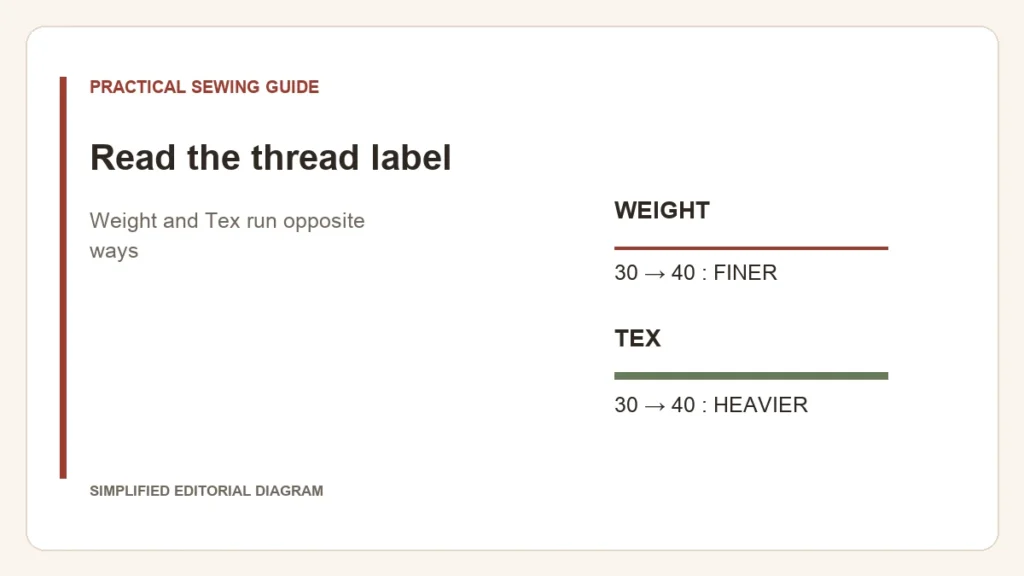
A 30-weight thread is thicker than a comparable 40-weight thread. With Tex, the direction reverses: Tex 40 is heavier per unit length than Tex 30. First identify the system; comparing bare numbers from two spools can reverse your intended choice.
| Label system | What increases with the number | Example within that system |
|---|---|---|
| Weight / wt | Length per fixed mass; the thread becomes finer | 40 wt is finer than 30 wt |
| Tex | Mass per 1,000 metres; the thread becomes heavier | Tex 40 is heavier than Tex 30 |
| Denier | Mass per 9,000 metres | A larger denier denotes greater mass for that length |
A conversion describes mass, not every sewing property
The SCHMETZ thread-sizing guide defines these systems. Using those definitions, 1,000 divided by 40 gives Tex 25 for a 40-weight thread. That calculation does not identify fibre, surface finish or the exact physical diameter of every thread sold with that label.
Imagine replacing a spool because you want a more visible topstitch. Buying a numerically larger “weight” could make it finer instead. Buying by the intended purpose and the complete label avoids that mistake; a conversion alone cannot establish whether it will run well through your machine.
Translate the label into a sewing choice
- Machine: confirm the permitted thread range and whether the intended use is sewing, embroidery or another stitch system.
- Needle: the thread must pass comfortably through the eye, but the needle also has to suit the fabric and machine.
- Result: compare stitch formation and appearance on the actual layers after changing thread, rather than preserving the old settings by habit.
The needle size and type guide covers that separate choice. If the spool label is ambiguous, ask the thread maker for the sizing system and recommended application. Keep both the product name and its numbering system in your project notes; “used size 40” is not enough to recreate the result.