Sewing Machine Guide

  • Home
  • Reviews
  • Best
    • All Best Picks
    • Computerized
    • Embroidery
    • Mechanical
    • Quilting
  • Guides
    • All Sewing Guides
    • Computerized
    • Embroidery
    • Mechanical
  • Comparisons
    • All Comparisons
    • Computerized
    • Embroidery
    • Mechanical
    • Straight-Stitch
  • Favorites
Guides

Reverse vs Locking Stitches: Two Ways to Secure a Seam

2 min read
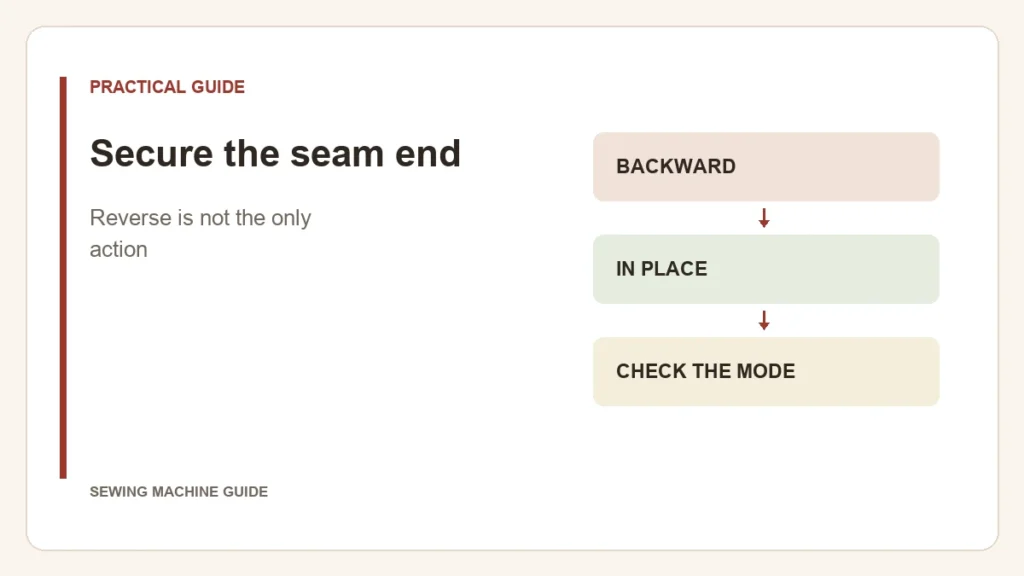
Editorial diagram: Secure the seam end. backward, in place, check the mode.

Table of Contents

Watch what the fabric does when the securing control is pressed. If it travels backward over the seam, the machine is reversing. If it stays in one place while several stitches form, it is reinforcing in place. The same button may do different things with different stitch selections.

Three operations at a seam end

Reverse → reinforce → trim are not interchangeable

  • Reverse: stitches travel back over a section.
  • Reinforcement in place: stitches secure a point without the same backward travel.
  • Trimming: threads are cut; that alone does not establish a secure end.

Brother’s SE700/SE725-family instructions describe reverse movement and three to five reinforcement stitches in one place, depending on the pattern. That count belongs to the documented example, not every machine’s locking function.

Choose the action from the stitch chart

Situation Question to settle before sewing
Ordinary plain seam Which documented securing method suits the fabric and construction?
Decorative motif Does the control complete the motif before reinforcement, or stop it where pressed?
Automatic end sequence Is reinforcement enabled, and does it happen before cutting?
Delicate or bulky edge Does the selected method hold without creating an excessive lump or drawing the edge into the plate?

Try the selected sequence on the actual fabric and inspect both sides. More repeated back-and-forth stitching is not automatically better. Choose the least bulky documented method that produces a sound end.

Why “lockstitch machine” does not promise a locking button

Lockstitch also names the stitch system in which needle and bobbin threads interlock. That description does not establish that the controls include a separate reinforcement-in-place function.

An overlocker uses a different thread chain and generally does not follow this reverse-sewing routine. Use the serger seam-end methods for that mechanism rather than trying to imitate a domestic machine’s button sequence.
Share this article

Twitter Facebook LinkedIn Email

Related Articles

Simplified editorial diagram: Hold the layers together. Choose the basting method.

Quilt Basting: Pins, Spray or Thread Before Machine Quilting?

Read More
Original editorial illustration for How to Clean a Sewing Machine Without Assuming It Needs Oil

How to Clean a Sewing Machine Without Assuming It Needs Oil

Read More
Simplified editorial diagram: A ridge between the rows. Flattening is only one test.

Coverstitch Tunneling: Flatten the Ridge Without Losing the Seam

Read More

About Sewing Machine Guide

Independent sewing machine reviews and practical buying guidance.

Your trusted source for honest, in-depth product reviews and comparisons.

Quick Links

  • Home
  • Reviews
  • Best Articles
  • Comparisons
  • Guides
  • About
  • Contact
  • Privacy Policy

Categories

  • Computerized Sewing Machines
  • Coverstitch Machines
  • Embroidery Machines
  • Handheld Sewing Machines
  • Industrial
  • Mechanical Sewing Machines

© 2026 Sewing Machine Guide. All Rights Reserved.

As an Amazon Associate I earn from qualifying purchases. We may also earn from other retailer links. Affiliate disclosure