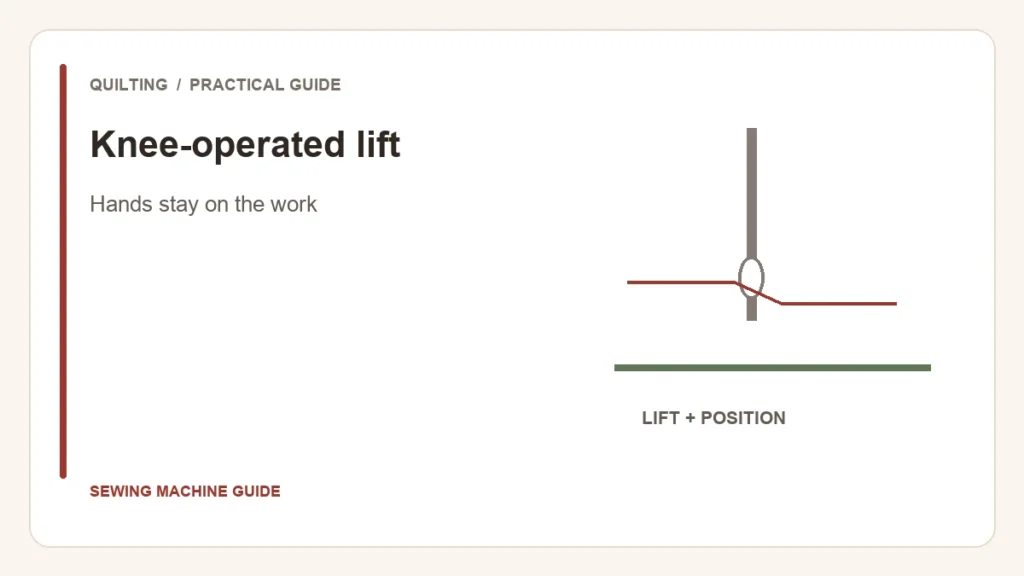
A knee lifter operates the presser-foot lift on a machine designed for it. It can leave both hands available to position the work. It is not a foot pedal, motor-speed control or automatic guarantee that the needle stops down.
Look at the repeated motion it would replace
Pivoting and positioning
Consider how often you reach for the foot-lift lever while holding a corner or layered piece.
Long uninterrupted seams
The lifter may matter less when you rarely stop to reposition the work.
A knee-operated lift is worth assessing when the reach interrupts a task you repeat. It is less persuasive as an isolated feature tick. Try the complete motion: stop sewing, keep the work controlled, lift the foot, reposition and resume by the documented method.
The mechanism and adjustment are model-specific
Janome’s Horizon Memory Craft 9410QC manual describes its optional knee lifter and adjustment. That documentation establishes the accessory for that machine; it does not make the rod interchangeable with another model. Confirm whether the exact offer includes the approved part.
| Check | Question for a demonstration |
|---|---|
| Accessory identity | Is this the correct lifter for this machine? |
| Installed table | Does the rod clear the table or cabinet? |
| Seated position | Can you reach it without twisting or losing pedal control? |
| Neutral position | Can you sit normally without lifting the foot accidentally? |
| Needle behavior | How is needle position controlled before a pivot? |
Test it in your actual seating arrangement
A showroom table can make a control feel easy that is awkward at home. Record table height, chair position and where the foot controller sits. If possible, repeat the demonstration with those conditions. Avoid deciding from a standing reach toward a machine that you will use seated.
- Have the approved accessory installed according to the manual.
- Check comfortable reach while the machine is safely stopped.
- Learn the amount of movement needed for the intended lift.
- Practice the documented stop-and-pivot sequence on scrap.
- Confirm you can return to a normal seated position without unintended pressure on the lifter.
Keep lift, needle stop and speed control separate
Those functions can work together but solve different problems. A machine may offer one without the others. The control comparison for mechanical and computerized machines helps separate them when choosing a machine. Do not infer electronic speed limiting from a knee bar pictured in a listing.
Choose it for a repeated task and a comfortable fit
A well-positioned lifter can remove a hand movement from repeated repositioning. If the table obstructs it or your seating makes accidental contact likely, resolve the installation before using it. The best demonstration ends with a comfortable complete seam sequence, not just a raised presser foot.