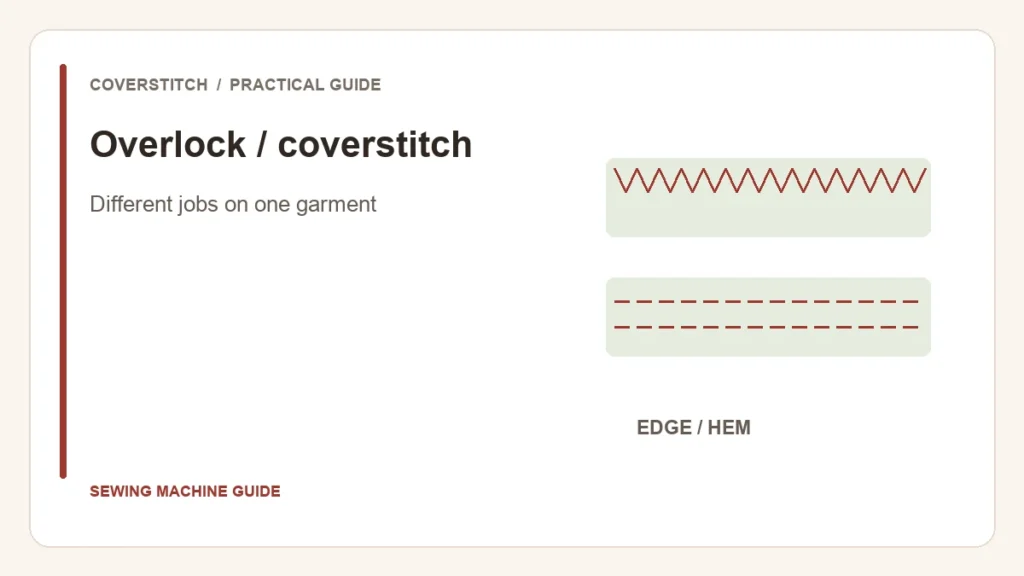
Choose a coverstitch machine for the supported hem and surface-stitching work you need; choose an overlocker for supported edge wrapping and trimming. Owning one does not establish that you already have the other stitch.
| Job | Overlocker | Coverstitch machine |
|---|---|---|
| Join and neaten a suitable knit seam | A common four-thread use | Do not assume an overlock construction stitch |
| Wrap a raw allowance while trimming | Typical overlock role | Not the ordinary coverstitch role |
| Sew parallel rows over a turned knit hem | Requires explicit coverstitch capability | A principal reason to investigate it |
| Insert zippers or make buttonholes | Keep a suitable sewing machine | Keep a suitable sewing machine |
As a concrete example, Brother’s 2340CV specifications list coverstitch and chain stitching, including narrow and wide coverstitch, while overlock width is not applicable. A product being grouped with sergers on a store site does not establish an overlock function. Read the formations, not only the shopping category.
Follow one garment through both stations
Imagine sewing several knit tops. First list construction seams, then sleeve and body hems, then any decorative or binding work. Mark where you would need to switch formations. That sequence reveals whether the second capability is a recurring need or an occasional finish you can already achieve another way.
Separate machines
Consider the space for two threaded stations and the benefit of returning to a ready setup.
Combination machine
Check the exact conversion process, included components and all required formations. A broad label is not a demonstration.
A useful demonstration includes the awkward part
- Ask to see the hem start, finish and overlap on the actual type of knit.
- Check access for the smallest sleeve or opening you plan to sew.
- Inspect the underside as well as the parallel rows on top.
- Stretch the finished sample as the garment will stretch and look for broken stitches or distortion.
- For a combination model, include a complete conversion and a return to the original stitch.
These are acceptance questions, not a promise that every machine can handle every opening or thickness. A large flat sample leaves access and seam-junction questions unanswered. The 2340CV manual is the authority for that model’s threading, settings and work removal; do not transfer an overlocker’s chain-off routine without checking.
Buy the missing operation
If raw edges and construction seams are the bottleneck, start with the serger versus sewing-machine decision. If those are covered and stretch hems recur, investigate coverstitch. Keep a conventional machine for the remaining garment operations instead of expecting either specialist to replace it.