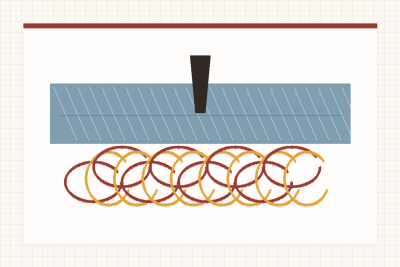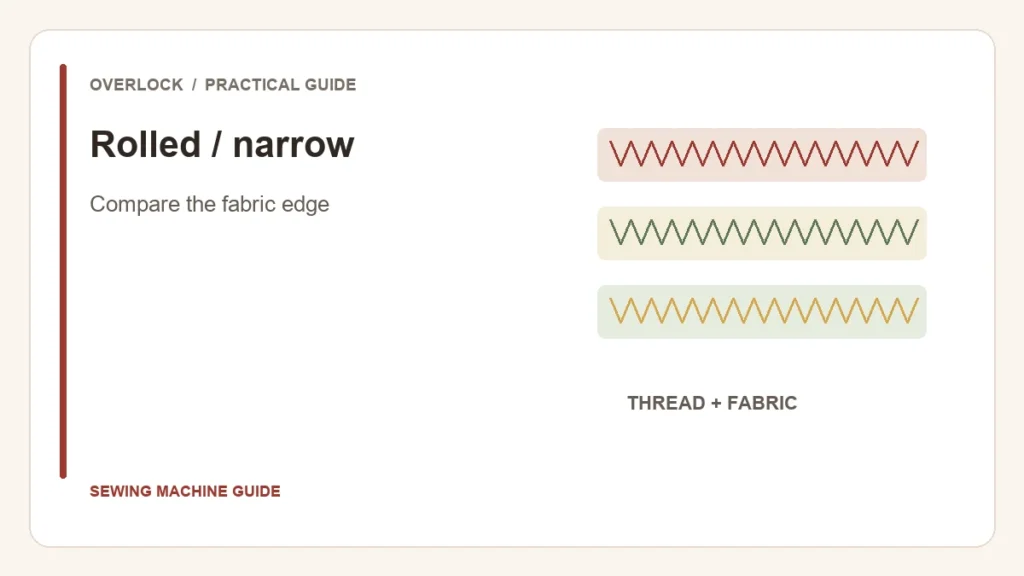
A rolled hem deliberately curls a small fabric edge into the thread wrapping. A narrow overlock finish is narrow without necessarily producing that same roll. Check the stitch diagrams in your manual: “narrow hem” is not a reliable universal name across brands.
Look at the edge, not just its width
Rolled edge
The small fold becomes part of the thread-covered finish.
Narrow overlock
The manual’s narrow edge formation may leave a flatter allowance.
Folded sewing-machine hem
A different construction, even when the finished width looks similar.
BERNINA describes rolled hemming as an edge treatment rather than a construction seam. Its looper thread draws the edge into a small fold. This makes the finish useful to investigate for exposed lightweight edges, not as a substitute for the seam joining garment pieces.
The conversion is more than a tension change
On the BERNINA L 460 example, the rolled-hem setup changes the stitch-finger arrangement, stitch length, cutting width and thread tensions. The manufacturer’s lesson gives that model’s sequence. Other machines may use a different lever or removable component; use their instructions and retain any part needed to return to ordinary overlock.
- Find the exact rolled and narrow stitch diagrams before unthreading.
- Confirm the permitted needle and thread configuration for each.
- Change components with the machine in the documented safe state.
- Make both samples on spare fabric from the project, including the same edge direction.
Compare what happens after sewing
| Sample result | Decision |
|---|---|
| A stiff cord-like edge | Check whether dense coverage suits the garment’s drape. |
| A flat, flexible narrow finish | Compare its exposed appearance and fraying resistance. |
| An unwanted wave | Investigate feeding; a decorative lettuce edge is not the same goal as a flat hem. |
| Thread builds up at the start | Recheck the documented starting position and whether the fabric is feeding. |
Judge the edge on a hanging or draped sample when that is how it will be worn. A short strip held flat on the table can conceal an edge that feels too rigid for a scarf. If the fabric cannot tolerate the proposed finish, choose a different hem rather than increasing tension indefinitely.
Return to an ordinary seam deliberately
Label the sample and note the conversion settings. Before the next construction seam, restore every changed item from the manual, including the stitch finger where applicable. An overlocker’s edge treatments are useful additions to a sewing workflow, but they should not silently carry over into unrelated seams.