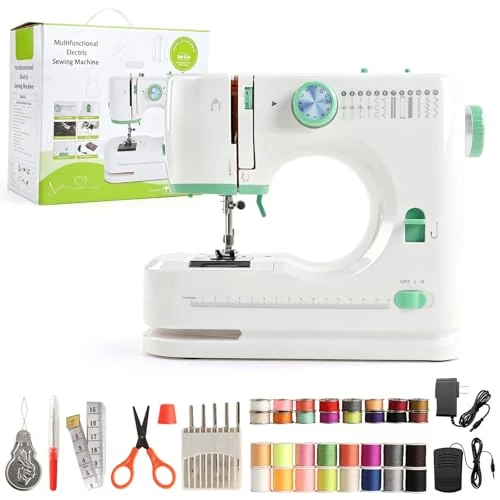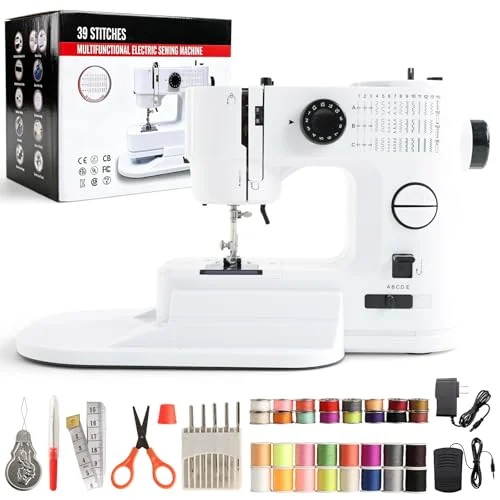
Between these two BJSWNLY offers, the useful first question is whether you need an extension table or prefer less weight to carry. The 39-choice package includes the table and is listed at 6 lb; the 12-stitch offer is listed at 4.6 lb. Neither the larger stitch total nor the extra weight establishes better sewing.
The differences you can base a purchase on
| Decision | 12-stitch offer | 39-choice offer |
|---|---|---|
| Exact ASIN | B0GS2C3SW5 | B0GS2LBNDG |
| Listed weight | 4.6 lb | 6 lb |
| Fabric support table | Included table not established | Included; discussed by owners |
| Stitch total | 12 selections; an owner identifies straight-stitch length variations | 39 advertised; an owner describes 13 patterns at three lengths |
| Speed settings | Low/high listed | Two and five both appear in the listing; unresolved |
| Shared listed conveniences | Reverse, LED, bobbin winding, pedal and button operation | Reverse, LED, bobbin winding, pedal and button operation |
Weight and package statements come from the exact 12-stitch listing and 39-choice listing. The stitch breakdowns above are attributed owner descriptions, not an independently verified chart comparison. The number 39 should not be read as 27 additional independent seam types.
Would the table solve your actual problem?
Cloth falls beside the small bed
The 39-choice package has a relevant advantage: a place to support fabric next to the needle. Owners describe appreciating that attachment. It can be useful without implying that the motor, feed or stitch formation is better.
The repair will not fit or feed
A table does not add presser-foot clearance or throat space. If a folded hem jams under the foot, a larger support surface is not evidence that this other mini will handle it. Compare the actual seam and controls with a conventional machine before buying another small package.
Carry weight is clearer than stitch-count arithmetic
The listed difference is 1.4 lb. That favors the 12-stitch offer when frequent lifting matters and the table has no job in your projects. It does not prove a smaller assembled footprint: the sellers list dimensions without a sufficiently clear common measurement orientation for that conclusion.
Both customer pools contain praise for moving and storing the machines. The 39-choice owners also flag the small pedal, while the 12-stitch accounts mention cramped thread access and a short lead. These are different workstation concerns. Make room for your hands, pedal and power connection, not just the machine body.
Successful light repairs do not settle reliability
The 12-stitch feedback includes completed light trouser hems and a tote lining. The 39-choice feedback includes a parent reporting jeans hemming and another owner beginning a quilt. Those are separate experiences on different work, not a head-to-head fabric test. They cannot establish that the 39-choice unit is a denim upgrade.
There are also failures relevant to modest projects: persistent skipping and tangling on a 12-stitch unit, and sticking while adding elastic to thin pants on a 39-choice unit. Neither sample supports a failure percentage or a durability winner. If a correctly set-up machine repeatedly fails, use the symptom-based troubleshooting guide rather than treating every jam as an invitation to tighten tension.
For the full model-specific evidence, see the BJSWNLY 12-stitch review and BJSWNLY 39-choice review. If repeated garment making or easier working space is the priority, the mini versus full-size guide is the more important comparison.