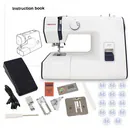
The Necchi EV7 is a compact, dial-selected machine for someone who wants a modest sewing setup rather than a large stitch library. Its appeal is straightforward mending and small household projects. The trade-off is a preset stitch-selection routine: this is not the model to buy expecting separate length and width controls for every pattern.
This assessment uses the EV7 instruction book, not a hands-on test. The historical “free accessories bundle” describes a seller offer; it does not establish what a machine advertised today will include.
Look at the selector before counting stitches
The EV7 manual identifies a pattern dial, a fold-out stitch chart and an upper-tension dial. It also documents a needle threader, a removable accessory table that exposes the free arm, and a reverse control that must be held while sewing backward. Those are useful everyday functions, but they are not programmable controls.
A preset menu can make occasional repairs easier to start: choose the illustrated seam rather than setting several independent dials. It is less accommodating when a pattern calls for a precise setting outside the available choices. Before buying, ask to see the selector clearly and compare it with the stitches in your next project, not just a seller’s total.
Two setup details that a compact label can hide
The lower thread uses a removable bobbin case. Learn its insertion and threading sequence rather than adapting instructions for a drop-in bobbin. The threading guide explains why access and thread direction must be checked separately.
For buttonholes, the EV7 uses a sliding foot and a four-stage selector sequence. You mark the length and manage the stages; it is not a button-sized one-step operation. A shirt with several matching buttonholes is therefore a different workload from an occasional cushion repair.
The instruction book supplies a darning-plate procedure. Do not mistake a plate covering the feed teeth for a built-in drop-feed lever, or freehand embroidery instructions for automatic design embroidery.
Pack a usable kit, not just a light machine
- Confirm the controller and power connection match the unit’s rating label.
- Check for the bobbin case, correct bobbins, spool fittings and sliding buttonhole foot.
- Separate the ordinary accessories from any extra feet, thread or carry bag promised by the seller.
- Ask how missing items and an unsuccessful sewing test are handled before ordering.
A carry handle is convenient, but it does not tell you the packed weight or protect the machine in transit. We have not verified a machine-only weight from the EV7 documentation and do not use a retailer shipping figure as a portability specification.
Where the EV7 makes sense
Keep it in consideration for a small, occasional sewing station if the preset menu covers your needs and the individual machine works correctly. Prefer more adjustable controls if you regularly change stitch dimensions or make garment buttonholes. The Necchi FA16 assessment explains that different control approach without treating the two models as interchangeable.
Documentation checked September 9, 2026: Necchi EV7 instruction-book reproduction, especially parts, bobbin setup, stitch selection and buttonholes. No current bundle, price or reliability rating is inferred from that manual.