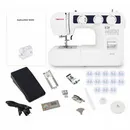
The Necchi FA16 is worth examining as a first garment machine because it separates stitch selection from length and width adjustment. That gives it a different learning curve from a compact machine with fixed presets: more choices to understand, but more ways to adapt a seam without changing machines.
Start with a seam you can adjust
The FA16 instruction manual shows independent pattern, length and width dials, a needle threader, a top-access bobbin and a free arm. Its straight-stitch instructions also cover variable needle position. For a learner, the practical benefit is being able to see which control changed a seam rather than relying on an unexplained automatic setting.
That flexibility is useful only when adjustments are deliberate. Keep a sample with the starting settings, change one control and compare the result. If a seam suddenly loops, return to the threading baseline before using the tension dial to disguise a missed guide. Our thread-bunching diagnostic follows that order.
The buttonhole is still a four-stage job
The exact FA16 manual specifies a four-step buttonhole with a sliding foot. It is not the automatic-size one-step system found on some other Necchi or Janome machines. The operator needs to mark the opening and follow the selector stages on a stabilized sample before sewing the garment.
For a first skirt or a simple repair, that extra sequence may be perfectly acceptable. For several shirts with closely matched buttonholes, it becomes a repeated task worth comparing with a one-step alternative. A larger stitch count alone would not remove it.
Drop feed is a setting, not a quilting package
A feed-dog control is documented, alongside ordinary utility and decorative sewing. Lowering the feed changes how fabric advances; it does not establish that a suitable free-motion foot, extension table or quilting bundle is supplied.
Ask for exact compatibility before buying an extra foot. A foot that snaps onto the holder still needs the correct needle clearance for the selected stitch. Switch off for changes and check clearance as the instructions require, rather than trying an unfamiliar combination at speed.
Price the actual FA16 offer
The old listing’s “free accessories” wording should not be treated as a permanent feature. Request an itemized carton list, including the controller, bobbins, spool holders, zipper foot and sliding buttonhole foot. Identify separately anything presented as a bonus, and verify the return and service arrangements for the particular unit.
Our conclusion is conditional: the FA16’s visible adjustments make a coherent garment-learning platform when the machine is complete and supported. Buyers who want fewer decisions should inspect the EV7’s preset approach; buyers who need speed limiting should compare actual controls rather than assuming every mechanical model lacks it.
This is a documentation-based review, not a sewing test. Source: the original FA16 manual reproduced by ManualsLib, checked September 9, 2026. Its parts, adjustment and buttonhole sections establish the functions discussed here, not current stock or bundle contents.