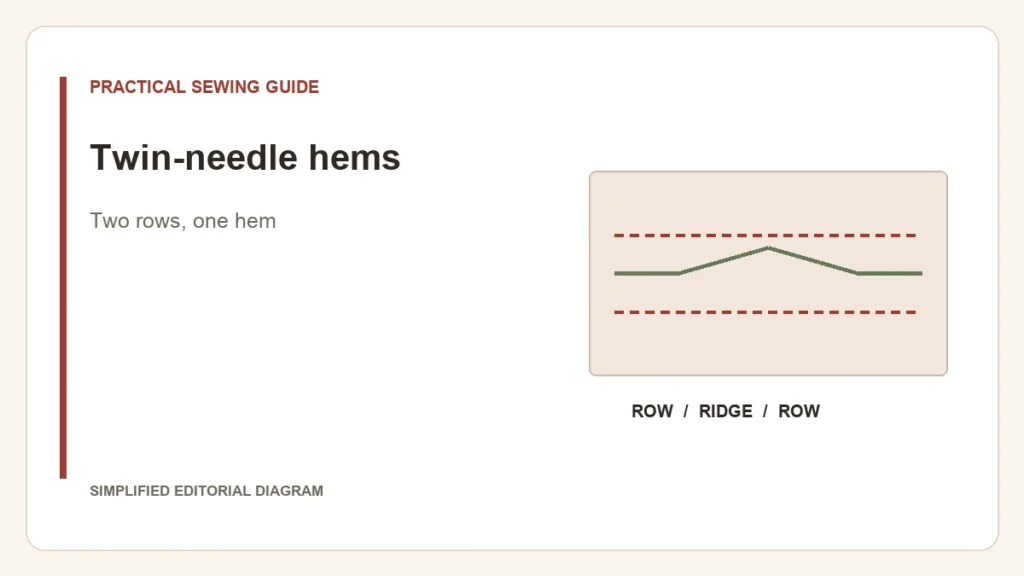
Two neat rows on top do not prove that a knit hem will stretch comfortably. A twin needle uses two upper threads and one bobbin thread; it does not turn the machine into a coverstitch. Judge the finished hem on both sides and in use, not just while it lies on the table.
Before installing the needle
- Confirm the exact machine permits a twin needle, including its system, spacing, stitch and needle position. A wide plate opening alone is not approval.
- Use the manual’s two-thread route and permitted foot. Select any required twin-needle safety mode.
- Switch off for installation. Follow the manual’s clearance check; never run the motor to find out whether the needle will hit the foot or plate.
The Closet Core twin-needle tutorial explains the two-upper-thread arrangement and sample testing. Thread-guide details differ by machine, so its routing example is not a substitute for your manual.
Read the sample by its symptom
| Result | Next investigation |
|---|---|
| Both rows form, but fabric rises between them | Tunneling: compare the documented tension setup and suitable hem support on a new scrap. Do not begin by turning the bobbin-case screw. |
| One row misses stitches | Needle condition, correct knit needle type and the separate thread paths. A flatter hem will not cure a missing stitch. |
| Rows form and lie flat, but thread snaps when worn | The seam has not passed its required stretch test; reassess stitch formation and the intended finishing method. |
Use the actual fold depth and fabric layers. If you add temporary support, follow its removal and fabric-care instructions before assessing the result. A sample that works only while rigidly supported has not yet answered how the garment will behave.
Keep the useful distinction
A raised ridge between two rows is different from an entire edge stretching into waves. For the latter, follow the fabric-feeding diagnosis. If repeated knit hemming is the main job, compare the stitch systems in coverstitch versus serger rather than assuming all double rows are equivalent.