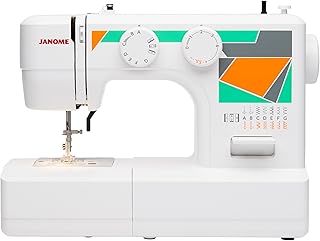
Janome 2212 Review: Honest Beginner Simplicity With Feed Limits
At a Glance
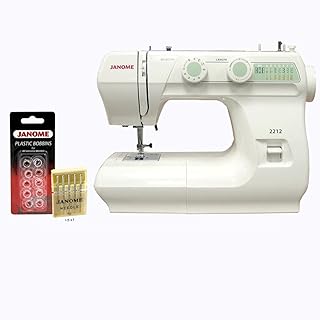
KEY FEATURES
- 12 built-in stitches
- Four-step buttonhole
- 5 mm stitch width
- Drop feed for darning
PROS
- Many beginners describe the machine as easy to understand
- Direct dials avoid menus and software
- The free arm and compact body suit hems, repairs and simple home sewing
CONS
- Some owners struggle with tension balance
- A few reports describe fabric failing to feed
- Layered seams can exceed the machine’s comfortable range
Editorial Rating
Based on supplied customer reviews and verified product documentation
Price and availability subject to change
An experienced sewer who gave away more elaborate equipment still needed an ordinary, full-size machine. That is a useful way to approach the 2212: choose the adjustments and seams you need, then decide whether its traditional bobbin and manual routine suit you. A short stitch menu is not itself a guarantee of easy sewing.
A simpler replacement can still be a full-size machine
Twelve stitches cover straight, zigzag, stretch and basic finishing without encouraging a beginner to substitute options for technique. The four-step buttonhole is less automatic but easy to understand once practiced.
Choose it for hems, curtains, pillowcases and learning seam fundamentals. Pay more for adjustable pressure, a one-step buttonhole or speed limiting if those controls will solve a known need.
Successful zigzag is a concrete outcome
One supplied owner describes extensive use and dependable zigzag after frustration with an older machine. Another experienced user valued explicit illustrations and familiar mechanical adjustments. Those accounts explain the appeal of the 2212 without assuming that a beginner needs exactly the same features. A learner who needs help limiting speed, seeing the needle eye or making buttonholes may make a different choice even when the basic stitches are sufficient.
The bobbin routine is part of the bargain
Front-loading bobbins and manual tension reward following the diagram exactly. Several negative reviews involve loops or feed trouble, so rethreading with the presser foot raised should be the first diagnostic step.
Ordinary repairs and troublesome layered seams
The 2212 works best on ordinary garment fabrics and small household projects. One owner specifically found even light layered cotton difficult, which is a useful boundary for buyers planning bags or thick quilts.
Pros & Cons Analysis
Based on supplied customer reviews and verified product documentation
Pros
- Basic adjustments can be enough for experienced users. A long-time sewer replacing more elaborate equipment valued adjustable straight and zigzag stitching and clear illustrations. The attraction is direct access to the needed controls, not merely having fewer features.
- Ordinary stitching has meaningful owner examples. Another owner describes extensive sewing with consistently usable zigzag after frustration with an older machine. This supports an everyday repair role without turning one successful unit into a reliability guarantee.
- The conventional layout can be reassuring. The experienced owner appreciated a full-size, stable machine and familiar accessories. That is a useful distinction for someone considering a very small machine chiefly to save space.
Cons
- The bobbin arrangement still needs learning. A front-loading case suited the experienced owner but was acknowledged as a possible drawback for others. Its insertion routine is a practical part of the purchase, not something removed by simple stitch dials.
- Tension and feeding complaints limit the easy-to-use promise. Other supplied owners report difficulty balancing stitches or moving fabric. Assess those reports alongside the successes; basic controls do not mean every delivered machine or construction will behave well.
- Bulky seams remain a separate test of suitability. Reports of layered-seam difficulty prevent extending ordinary repair success to all thick joins. The important difference is the completed seam construction rather than the number of stitch choices.
Our Verdict
The strongest reason to buy
True beginners making simple garments, repairs and household projects.
Twelve stitches cover straight, zigzag, stretch and basic finishing without encouraging a beginner to substitute options for technique. The four-step buttonhole is less automatic but easy to understand once practiced. Many beginners describe the machine as easy to understand.
The boundary that decides it
- Some owners struggle with tension balance.
- A few reports describe fabric failing to feed.
- Layered seams can exceed the machine’s comfortable range.
Our final recommendation
Choose it for hems, curtains, pillowcases and learning seam fundamentals. Pay more for adjustable pressure, a one-step buttonhole or speed limiting if those controls will solve a known need. The supplied 100-review sample supports product-specific observations, not a statistical failure rate. Buy only after the exact seller bundle and return terms are clear, then complete the arrival checklist while every remedy remains available.
Frequently Asked Questions
What is the Janome 2212 best for?
True beginners making simple garments, repairs and household projects.
What is its most important limitation?
Some owners struggle with tension balance.
Which feature matters most in comparison?
12 built-in stitches is the clearest product-level distinction.
What should I test after delivery?
Thread and wind the bobbin from the manual, test the main controls on two fabric weights, and exercise the specific functions mentioned in negative owner reports.
How strong is the review evidence?
The supplied exact-product set contains 100 owner-review texts. It supports recurring themes and specific warnings, but not failure-rate claims.
Technical Specifications
| Machine class | Basic mechanical domestic sewing machine |
|---|---|
| Control type | Mechanical dials and foot control |
| Primary functions | Repairs, garments and crafts |
| Built-in stitches / applications | 12 built-in stitches |
| Maximum stitch length | 4 mm |
| Maximum stitch width | 5 mm |
| Needle threader | No |
| Bobbin / looper system | Front-loading oscillating hook |
| Buttonholes / eyelets | 1 four-step buttonhole |
| Warranty | Janome limited warranty; coverage varies by component and seller—confirm current US terms |
Janome 1522DG Review: Simple Controls, Strong Seam-Crossing Manners