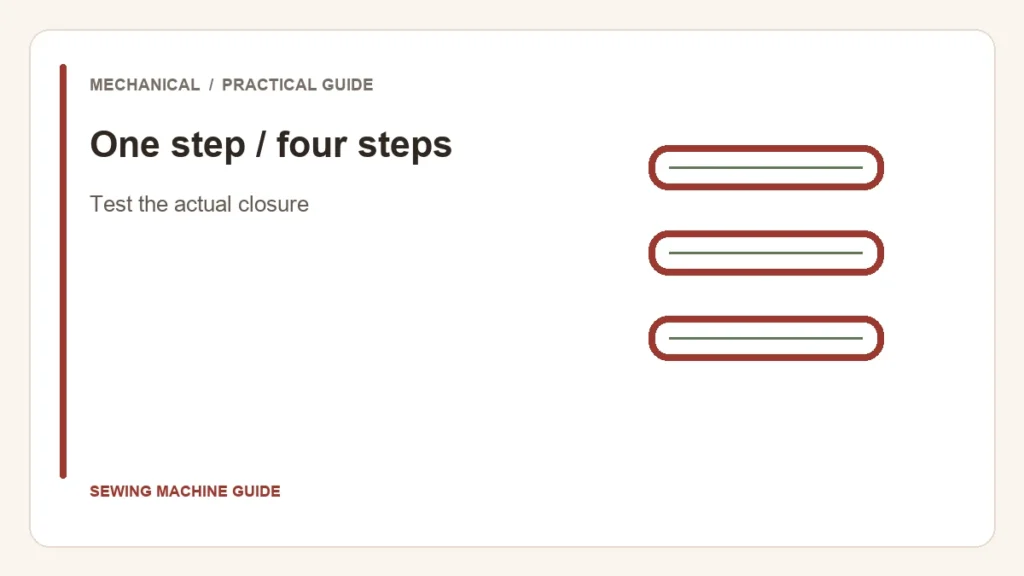
One-step and four-step describe how the buttonhole sequence is controlled. They do not guarantee the finished opening will suit every button or fabric. Compare the complete closure on the actual garment layers, especially when you need a row of matching buttonholes.
One-step
The machine performs the supported sequence after the required setup.
Four-step
The operator changes stages in the documented order and controls their placement.
Automation reduces repeated actions, not preparation
A one-step system can make repeated closures more convenient, but the correct foot, sizing method, lever position and fabric support still matter. A four-step system asks more of the operator during the sequence; it can still be adequate when buttonholes are occasional and the sample is satisfactory.
The Brother JX3135F manual documents a four-stage buttonhole. Do not transfer that selector sequence to a one-step model or assume every machine illustrated in a shared manual has the same controls.
Test a closure rather than a rectangle
- Build a scrap with the same fabric, interfacing and seam bulk as the intended opening.
- Use the actual button and the machine’s documented sizing process.
- Sew the buttonhole with the correct foot and setup, following the exact sequence.
- Open the sample using the method and tool precautions in the instructions. Keep the garment itself out of this first test.
- Pass the button through and check the opening, fabric distortion and stitching at both ends.
- Repeat the sample to see whether the result is consistent enough for the planned row.
| If you sew… | Give extra weight to… |
|---|---|
| An occasional repair | A clear setup you can repeat after time away. |
| Shirts with many closures | Repeatable length and shape across the full sequence. |
| Closures near a bulky seam | Foot support and feeding on the actual layered sample. |
| Different button styles | The available formations and permitted size range. |
A failed side does not prove the machine type is wrong
First check the model’s setup and troubleshooting. Brother’s buttonhole support example includes a lever check and model-dependent feed adjustments. Its dial positions and screws should not be copied to an unrelated machine.
Choose repetition you can trust
Prefer the system that produces the needed closure consistently with your material and controls. For the broader purchase, mechanical versus computerized operation explains why buttonhole automation is only one part of the interface. More stored shapes do not compensate for an unsuitable opening on the garment you actually sew.