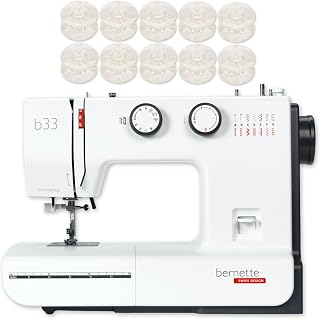
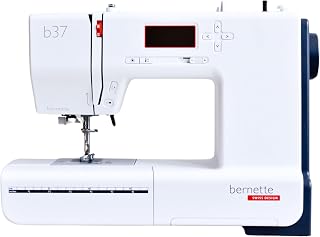
Bernette B33 vs B37 is a genuine mechanical-versus-computerized fork. The B33 suits a buyer who wants direct dials, 15 stitches and no screen. The B37 is the stronger general recommendation when an adjustable speed ceiling, start/stop sewing, programmable needle stop, wider stitches and one-step buttonholes reduce daily friction. Their 170-mm workspace is the same, so the upgrade does not buy more room for bulky projects.
The upgrade changes control, not physical workspace
Both machines publish 170 mm of space to the right of the needle and include five presser feet. The B33 is mechanical, offers 15 stitches and uses a front-loading CB hook. The B37 is computerized, offers 50 stitches and uses a top drop-in rotary system. Its 700-spm maximum is lower than the B33’s 860, but maximum speed is not the decisive advantage.
The evidence includes seven supplied B33 owner texts and 20 B37 texts. These small exact-product samples can identify individual and recurring questions but cannot support reliability percentages. The site did not physically test either model.
The B37 is slower on paper and easier to contain
The B33 relies on the foot pedal for every speed decision. One detailed beginner report found that difficult to control. The B37 adds a speed slider and start/stop button, allowing the operator to cap speed before pressing the pedal or sew without it. For learning, appliqué and detail work, that control can matter more than the B33’s higher maximum.
Direct cause and effect
Dials and pedal control keep the interface visible and mechanical.
Set a ceiling before the seam
The slider reduces dependence on perfect ankle control.
The throat does not grow
Both retain a modest 170-mm workspace for quilting bulk.
Bobbin and buttonhole routines move in opposite directions
The B33’s front-loading CB hook appeals to sewists familiar with a removable case, but it adds access steps. Its single buttonhole is a four-step process. The B37 uses a top drop-in rotary bobbin and documents five one-step buttonholes, reducing routine handling for garment makers who repeat them.
Does computerized control make the B37 automatically better?
No. It makes speed, stitch selection and needle position easier for some users, while adding an electronic interface that others do not want. The correct choice depends on which workflow reduces errors for the buyer.
If user-adjustable foot pressure is a requirement rather than an optional extra, look beyond this pair: the Janome Sewist 740DC documents a pressure dial alongside direct stitch selection. That is a separate alternative to assess, not a feature supplied simply by choosing computerized controls.
Fabric evidence supports cautious domestic expectations
B33 owners describe approachable, sturdy manual sewing, while the small file also includes speed-control difficulty, missing-cover or bonus issues and a wrong-voltage report. B37 owners often describe smooth, quiet sewing and beginner-friendly speed control. Reports become contradictory on heavy materials, and one detailed account describes inconsistent buttonholes.
That contradiction should remain visible. Neither machine should be declared heavy-duty from isolated success or failure. Test the actual garment fabrics and repeated buttonholes with suitable needles during the return period.
Mechanical simplicity and computerized assistance carry different risks
The B33 exposes most choices through dials and the foot pedal. That can make cause and effect easier to follow, but it also leaves low-speed control and needle placement to the operator. The B37 adds electronic selection and automation that can reduce routine mistakes, while introducing controls that a screen-averse buyer may not want and faults that are less likely to be user-serviceable.
Neither architecture is inherently more durable. Ask what happens when each machine needs timing, feed, display or control-board service in your area. Confirm the current warranty process and nearby technician capability rather than assuming that a mechanical model can always be repaired at home or that electronics are automatically disposable.
Project frequency determines whether fifty stitches matter
The B37’s extra stitches have value when decorative edges, quilting patterns or multiple buttonhole styles recur in actual work. A garment sewist may use the one-step buttonholes and needle stop every week even while ignoring most decorative options. Conversely, a repair-focused user may rely on straight, zigzag and stretch stitches and receive little benefit from the larger library.
Write down five recent projects and identify which B37-only control would have changed them. If speed limiting, needle stop or one-step buttonholes appears repeatedly, the computerized premium has a task-based case. If the answer is only “more choices,” the B33’s narrower design may be more coherent.
Portability does not solve the shared throat limit
Both machines occupy the compact domestic class and publish the same 170-mm right-side workspace. An extension table can support fabric at the same height, but it cannot enlarge that throat. Large quilt bulk still must pass through the existing opening, so buyers planning frequent bed-size quilting should compare wider machines instead of deciding between these two.
For garments, alterations and small quilted pieces, the shared space can be adequate. The decision then returns to control: direct pedal-and-dial operation on the B33 or adjustable electronic assistance on the B37. That is a more defensible distinction than using maximum speed as a proxy for capability.
Class portability should also be tested in the real room. Lift the machine using the documented handling points, check whether the cover and power equipment fit the storage location, and leave enough table depth for fabric to feed without dragging. A compact body can still feel inconvenient when setup requires moving unrelated household items every session.
If the B37 will remain permanently available, its start/stop and needle-stop controls can compound into meaningful convenience. If either machine must be unpacked for a few repairs per month, simplicity, cover completeness and fast setup may dominate the feature list. Purchase frequency of use, not aspiration, should decide how much automation is worth.
Noise and tactile preference also deserve a short in-person check when possible. Some sewists trust a mechanical dial they can feel without looking; others work more confidently after selecting a stitch and speed on a display. Neither preference is old-fashioned or advanced. The correct interface is the one that reduces hesitation and helps the operator notice when the machine behaves differently.
| Reader priority | Better fit | Decision reason |
|---|---|---|
| No screen or electronic stitch selection | B33 | Its dials provide direct mechanical operation. |
| A fixed low-speed ceiling | B37 | The slider reduces pedal sensitivity. |
| Frequent buttonholes | B37 | Five one-step styles replace one four-step process. |
| Large quilt bulk | Neither | Both publish the same 170-mm workspace. |
Match the failure consequence to your comfort level
A mechanical machine can feel easier to understand because controls act directly, but it still requires correct timing, tension and feed adjustment. A computerized machine can prevent certain operating mistakes through speed and needle controls, while electronic faults may be less user-serviceable. Neither architecture guarantees durability.
Try the controls before deciding which feels simpler
- Start at the lowest useful speed. Compare pedal-only B33 behavior with the B37 slider and pedal.
- Remove and reseat the bobbin. Decide whether front loading or top access is clearer for you.
- Sew repeated buttonholes. Run the complete four-step and one-step workflows on stabilized fabric.
- Cross a realistic seam junction. Use correct needles and listen for changes without forcing the machine.
- Verify package and voltage. Confirm all five feet, cover status, power equipment and market version.
The Bernette B33 review examines its direct mechanical brief, while the Bernette B37 review focuses on its everyday computerized controls. Browse mechanical machines or computerized machines for more alternatives.