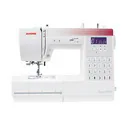
The Janome Sewist 740DC is appealing precisely because its feature list does not try to win through volume. Forty stitches, direct selection and adjustable presser-foot pressure form a practical garment-sewing brief. The important question is whether that focused interface suits your work better than a machine with a much larger library.
Twenty buttons, a second group and less searching
Janome’s global 740DC page describes 20 directly selected patterns plus another 20 accessed with the slide-out chart. Three buttonhole styles are included. This arrangement offers quick access to familiar stitches without making every pattern a separate control on the front panel.
For alterations and garment construction, try finding your straight stitch, edge finish and buttonhole before browsing the decorative choices. The time saved on a repeated operation is more relevant than how impressive the complete chart looks. Someone who wants extensive lettering or design combination should check that requirement separately rather than expecting it from the computerized label.
Pressure is a genuine adjustment, not a marketing synonym
The pressure dial changes how firmly the foot bears on the fabric; it is not the thread-tension control. On a difficult fabric, that provides another variable to investigate. It does not guarantee an ideal result without suitable needles, stitch settings and handling.
Make two samples on the same material with a documented setting change and inspect the seam after it relaxes. This gives the control a concrete purpose. A shopper who never changes fabric type may find speed and needle-stop functions more important, while a garment maker moving between materials may value the pressure adjustment highly.
A satin pattern can grow without enlarging the machine
The 740DC supports elongation of eligible satin stitches up to five times their normal length. That is a decorative-pattern function, not a promise that every stitch can be stretched or that the machine imports embroidery designs. Its stated workspace is 170 by 110 mm, so large-quilt handling remains a separate limitation.
An extra-wide table is listed as optional in Janome’s global information. Regional foot packages also differ, so obtain the exact local inventory instead of mixing accessories from different country pages. The body dimensions and an external support surface should both fit the space where you will sew.
Choose it for direct garment work
The Janome 6100 review offers another pressure-adjustable interface to compare. For the 740DC, the strongest case is a sewist who uses a restrained set of stitches frequently and wants electronic pace and needle-position assistance without a deep creative menu.
Before buying, confirm that the supplied buttonhole foot, cover and any table match the quote. Try one complete buttonhole on your intended fabric rather than treating the number of styles as evidence of the finished result.
Janome’s model page and Sewist 740DC manual support the specifications here. Fabric-handling observations are proposed evaluation steps, not reported laboratory or personal tests.