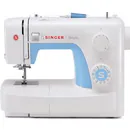
The Singer 3221 Simple provides a middle ground between fixed-preset beginner machines and more adjustable mechanical models. Its useful features are an independent stitch-length dial, a built-in needle threader and a one-step buttonhole. Do not assume it has every control shown in a manual shared with the 3232.
21 stitches do not tell the whole control story
Singer identifies 21 built-in stitches for the 3221. The length dial lets you adjust the seam rather than choosing only among fixed straight-stitch presets. Pattern selection remains mechanical, so a learner can see the setting without navigating a display.
The important qualification concerns width. The shared 3221/3232 parts diagram marks the separate stitch-width dial for the 3232 only. The exact German 3221 manual likewise shows length and pattern controls without that additional dial. Inspect the actual selector and stitch options if independent width adjustment is important to your work.
For a first project, that distinction is more useful than comparing stitch totals alone. A menu can include a decorative pattern without offering every adjustment you want for appliqué, narrow edge finishing or a particular fabric.
The buttonhole is a genuine convenience
The 3221 uses a one-step buttonhole and a dedicated buttonhole lever. With the correct foot and setup, this avoids the manual four-stage selector routine of the 1512 Promise II.
It still needs a sample. Use the intended fabric, interfacing and button, and check the finished opening before repeating it across a shirt or facing. A used offer missing its automatic buttonhole foot is not the same practical purchase as a complete kit.
A threader helps the last step, not the whole route
The built-in threader assists at the needle. The operator still has to route the upper thread through the guides, tension path and take-up lever, and correctly load the removable front bobbin case. If a seam loops, check the entire sequence rather than blaming the needle threader.
The threading guide provides a general checklist. Use the 3221’s own manual for needle orientation, bobbin direction and any special-needle restrictions.
Buy simplicity only when it fits the project
The 3221 is worth considering for ordinary domestic garments and repairs when its stitch choices and controls meet the brief. It should not be chosen as a heavy-material specialist merely because the frame is described as metal. Nor have we tested its noise, pedal response or long-term reliability.
Before ordering, verify the regional power rating, actual controller, required feet and service arrangements. Lighting and electrical specifications should come from that particular unit and manual, not a different-market listing. Compare other beginner options if an electronic speed limit or a broader adjustment range matters more.
Checked September 9, 2026 against Singer’s 3221 model page, its linked 3221 manual and the 3221/3232 parts diagram. The review is documentation-led, not a claim of ownership.