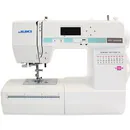
Twenty patterns can be a sensible limit if a machine still gives you control over pace and needle position. The Juki HZL-LB5020 follows that approach: it keeps a small stitch menu while retaining electronic assistance for ordinary home sewing. Its strongest argument is not maximum variety but a manageable set of functions.
A small menu does not mean pedal-only sewing
Juki’s LB5020 brochure specifies 20 patterns, three buttonholes and a maximum speed of 700 stitches per minute. It also documents speed control, needle up/down and automatic lock stitching. Those controls can be useful even to someone who rarely leaves straight and zigzag stitches.
For example, a lower speed ceiling can make a curved edge easier to approach, while a chosen needle-stop position reduces one step before turning the fabric. Neither function replaces guiding the work or selecting the appropriate setup. Their value is in making a familiar operation more deliberate.
The three buttonholes are a more useful count
The shared LB instruction book distinguishes the 20-pattern and 100-pattern machines. The LB5020 chart includes square, round-end and keyhole buttonholes. Look at those shapes against the garments you intend to make rather than treating the total pattern number as a quality score.
A complete buttonhole sample is also a good buying check. Use stabilized fabric of the intended type, the correct foot and the manual’s sequence. A machine displaying the right pattern number has not yet shown you how clearly you can set up that operation.
Know where the economical LB platform stops
The published maximum stitch dimensions are 7 mm wide and 5 mm long, with a machine weight of 5.6 kg. A hard cover is listed; a wide table is optional. Do not borrow the box-feed system or automated cutter features from Juki’s higher DX models simply because the brand name is the same.
Likewise, lowering the feed dogs does not make the supplied package a complete free-motion setup. Confirm a compatible foot and any other required equipment before budgeting for that work. For large projects, fabric support and the space inside the arm still need a separate assessment.
Pay for the LB5100 only if its extra patterns solve something
The HZL-LB5100 expands the library to 100 patterns while retaining the same advertised 700-spm ceiling. Its extra repair and decorative choices may be worthwhile, but the larger count does not establish a stronger sewing engine.
The LB5020 is the cleaner fit when your requirements already sit inside its smaller chart and you value uncomplicated electronic controls. Before choosing it, try the slider, needle-stop button and one complete buttonhole. That will tell you more about suitability than scrolling through patterns you do not expect to use.
This comparison of documented functions uses Juki’s brochure and LB-series manual, not an original hands-on performance test.