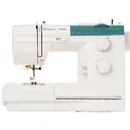
The Husqvarna Viking Emerald 118 is an important exception to the idea that a mechanically selected machine must have pedal-only speed control and no needle-stop choice. It retains direct stitch dials while adding a speed-limiting slider and a needle up/down button.
The two reasons to choose 118 over 116
The manufacturer’s shared Emerald manual explicitly assigns the speed slider and needle up/down control to the 118 and 122, not the 116. The slider limits maximum sewing speed even when the pedal is pressed fully. The needle button moves the needle and changes its stop position.
Those features answer practical questions: can you cap the pace while learning a curve, and can you leave the needle down when pivoting? They do not require a large electronic stitch menu to be useful. For a buyer who likes physical dials but dislikes an unrestricted pedal, this combination deserves a closer look.
Adjustment for the fabric, not just the thread
The 118 also has a presser-foot pressure dial, stitch length and width adjustments, a top-loading bobbin and a needle threader. The manual’s sewing reference chart relates fabric and technique to the setup; it is a starting reference, not a promise that every material will sew without sampling.
Foot pressure and thread tension solve different problems. Record the ordinary setup before changing either. For a garment, test an actual hem or interfaced facing as well as an uncomplicated seam. A machine can behave differently when the fabric thickness changes halfway through the work.
Buttonholes and feet need the correct model column
The manual documents an automatic buttonhole procedure, with the correct foot and button-size setup. Practice the entire sequence before cutting an opening. Consistency depends on fabric support and correct preparation as well as the mechanism.
Some accessories in the family manual are marked for the 122 only, including its gathering and quarter-inch piecing feet. Their presence in the book is not proof they ship with an Emerald 118. Request an itemized list if a retailer advertises a quilting or bonus package.
A useful hybrid, with ordinary domestic limits
We would investigate the 118 for someone who wants direct stitch adjustment plus assistance with pace and pivots. We would not infer industrial feeding, heavy-material endurance or superior reliability from those controls. The individual machine still needs slow-start, reverse, buttonhole and fabric tests.
Compare the Juki HZL-355ZW-A if pressure and dial adjustment matter more than the Emerald’s speed and needle controls. The control-style guide explains why exact functions are more useful than a simple mechanical/computerized label.
Source: Emerald 116/118/122 instruction manual, especially pages 6, 8 and the model-specific accessory sections; checked September 9, 2026. This is a manual-based assessment, not a hands-on review.