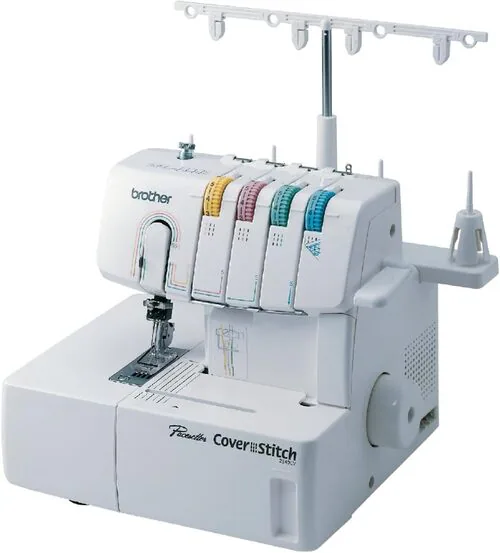
The ST4031HD is a three- or four-thread serger. Its useful comparison is about edge finishing, fabric support and the threading routine—not whether the “Strong & Tough” label guarantees every thick seam.
The table supports the work outside the machine
Brother’s ST4031HD specifications identify an extension table, differential feed, adjustable presser-foot pressure and standard, blind-stitch and gathering feet. The table helps support a project; it does not increase the space under the presser foot.
- Decide whether the main job is joining and finishing an edge or making a coverstitched hem. Those require different stitch capabilities.
- Consider the complete seam intersection, including folded allowances, when arranging a demonstration. Flat layers are not the same construction.
- Check the threading sequence in the exact manual rather than following a different serger’s color order.
Pros & Cons Analysis
Benefits and limits of the documented features.
Advantages
- The extension table is relevant when a project would otherwise hang from the edge of the machine. Assess the complete table footprint in your workspace.
- Differential feed and pressure adjustment provide separate controls to evaluate for the material you sew. Their presence is useful; a setting that works on one sample is not universal.
Limitations
- The specified maximum of 1,300 stitches per minute describes speed, not an independently tested heavy-fabric capacity or an easy minimum speed.
- Three/four-thread overlocking does not establish coverstitch capability. A buyer seeking T-shirt-style cover hems should compare the 2340CV’s purpose.
Our Verdict
Shortlist for supported edge finishing
Consider this package if the extension table and overlock functions solve an actual handling problem. Inspect the threading and start-up control as carefully as the blade. Durability requires separate ownership evidence; an accessory package alone does not establish it.