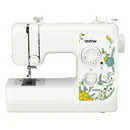
The Brother JX3135F is a basic mechanical sewing machine whose most important limitation is the way stitch settings are selected. It offers preset combinations rather than the separate length and width controls a buyer might expect from a larger dial-operated machine.
Identify the JX3135F, not just a similar Brother
Use the model label and the JX3135F entry in Brother’s support system. Several models share the instruction book, and sections marked for particular variants should not be treated as universal equipment. A nearby JX or LX model number is not enough to establish a feature.
That is especially important with a used machine sold without its carton. Ask for photographs of the controls, rating label, bobbin area and supplied controller. A decorative front panel can identify a style, but it cannot confirm the electrical version or what is included.
Preset sewing is a real trade-off
The manual’s pattern table assigns stitch lengths and widths to selector positions. Straight-stitch options and zigzag options are chosen from that menu; there is no separate continuous adjustment routine for each dimension as on more adjustable models.
For small woven projects, a suitable preset can be enough and keeps the setup short. The limitation appears when a pattern asks for a particular basting length, a narrower finish or a setting between the available choices. Read the chart before buying if such adjustments are common in your sewing.
Do not compensate for an unsuitable preset by pulling the material faster. The feed system should advance the fabric. If the required seam cannot be obtained within the documented settings, that is a machine-selection issue rather than a reason to force it.
Allow time for the four-step buttonhole
The buttonhole is a four-stage operation. The operator follows the numbered selector sequence rather than putting a button into an automatic-size foot and asking the machine to complete the whole opening in one setting.
A few practice openings on stabilized scrap will tell you whether that workflow suits the first project. Someone mainly repairing seams may barely notice the extra stages; someone making repeated garment closures has a stronger reason to compare a one-step machine.
A sensible first-session checklist
- Obtain the JX3135F support manual before substituting a general Brother tutorial.
- Verify the specified bobbin and needle, then complete both thread paths.
- Choose an ordinary straight-stitch preset and test controlled starts on scrap.
- Check reverse, a zigzag selection and the complete buttonhole sequence.
The threading guide explains the general checkpoints, while the beginner shortlist helps compare other control layouts. Neither replaces the JX3135F’s own diagrams.
Prepared from Brother’s JX3135F manual entry, checked September 9, 2026. This is a documentation assessment, not an owner test. We do not infer an automatic needle threader from a conditional section in the shared manual.