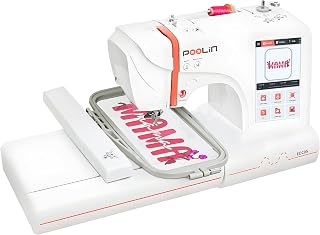
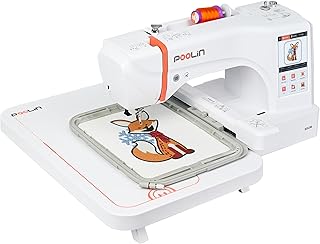
PooLin EOC05 vs EOC06 separates a narrow, long-format beginner machine from a substantially larger embroidery station. The EOC05 suits buyers whose designs fit within a four-inch width and who value a smaller commitment. The EOC06 is the choice when native 11 × 7.9-inch space and four included hoops solve real layout needs. Both remain embroidery-only and support-dependent setup is part of the ownership plan.
The model number hides a major change in scale
The EOC05’s maximum field is 4 × 9.25 inches, useful for narrow vertical or horizontal layouts but permanently limited to four inches across one dimension. The EOC06 expands to 11 × 7.9 inches, a different project class rather than a small upgrade. Both use seven-inch touchscreens and document USB plus Wi-Fi transfer.
This comparison uses 100 supplied exact-product owner texts for each model and normalized specifications. We did not physically test either machine. Owner reports can reveal setup and support themes, but they cannot prove failure frequency.
Hoop geometry should match the product you plan to make
The EOC05 includes 4×4 and 4×9.25 hoops. The EOC06 record lists four hoops: two 5.5-inch squares, one 7.9-inch square and one 11×7.9 rectangle. More hoops are valuable only if their geometry matches the actual design library and blank sizes. They also require storage, stabilizer planning and a surface large enough to keep the carriage path clear.
A narrower learning boundary
The compact field can simplify early project selection and supply planning.
Native large-layout freedom
The 11×7.9 field reduces splitting for jacket backs, signs and larger decorative work.
Support belongs in the workflow
Both owner files make responsive setup help part of the value proposition.
Speed and design counts are secondary to field fit
The EOC05 includes 130 designs and a 650-spm ceiling. The EOC06 raises those figures to 200 designs and 860 spm. Larger built-in libraries can be convenient, and speed becomes more relevant on high-stitch-count designs. Neither number fixes a poorly stabilized blank, incorrect bobbin setup or a file that does not suit the hoop.
Does the EOC05’s 9.25-inch length make it equivalent to the EOC06?
No. The EOC05 remains limited to four inches across its narrow dimension. The EOC06 supports layouts up to 11 × 7.9 inches, so its usable geometry is materially broader.
Owners repeatedly make support part of the verdict
EOC05 reports frequently praise direct help and successful beginner projects, while nesting and bobbin trouble recur and the four-inch width becomes a visible limit. EOC06 owners also describe good stitches and useful support, alongside nesting, alignment and individual defective-bobbin reports. Those patterns suggest that setup assistance can have real value, but buyers should still verify current contact routes and warranty terms.
The EOC06’s 29.8-pound published weight and large carriage make a dedicated surface sensible. The EOC05 is the more contained system, though its longer hoop still needs clear travel space. Neither should be placed where fabric or furniture can obstruct the moving hoop.
The software path must scale with the hoop
A larger field is valuable only when compatible files can be prepared, transferred and edited without turning every project into troubleshooting. Test both USB and Wi-Fi with a known file, then repeat the route with a design near the intended maximum size. Confirm format, stitch count, orientation and hoop selection before pressing start. A successful small built-in pattern does not validate the complete custom-design workflow.
The EOC05’s narrower geometry may encourage simpler files, while the EOC06 invites larger designs with more colors and stitches. That increases stabilizer, thread, bobbin and monitoring demands. The 860-spm ceiling reduces theoretical stitching time, but thread changes, trims, rethreading and corrections still dominate many home projects.
Large-field value includes the room around the machine
The EOC06 needs enough table depth for the 11×7.9 hoop to travel without hitting a wall, pile of thread or hanging fabric. The surface must remain stable under a nearly 30-pound machine, and supplies need storage near the workstation. If the only available routine requires lifting and clearing the dining table each time, the EOC05 may see more actual use despite its smaller field.
Measure doorway, shelf and table clearances before purchase, not after unboxing. Include the cost of a stable surface, surge protection, hoop storage and enough stabilizer for larger blanks. A cheap large-field machine can create an expensive unusable workflow when the room was never planned.
Support quality should be verified, not assumed permanent
Both supplied owner files contain positive support experiences, making assistance part of the evidence-backed value. Contact availability, response time and warranty procedures can change, so verify current routes on the purchase date. Save manuals, setup videos and correspondence locally in case a platform or listing changes.
Use support to resolve documented setup questions, but preserve the return window. Repeated nesting, alignment error or bobbin faults after correct setup should not be normalized simply because help is friendly. The goal is a functioning exact unit, not an indefinitely extended troubleshooting relationship.
For occasional gifts, a smaller machine that is easy to start may outperform unused capacity. For a home shop producing large personalized pieces, the EOC06 can reduce rehooping and open layouts that the EOC05 cannot execute natively. Neither case proves business profitability; calculate material, thread-change, finishing and correction time separately from maximum sewing speed.
Availability of hoops and replacement consumables also belongs in the decision. Confirm current bobbins, needles, hoop compatibility and service parts before building a workflow around either exact model. A large field loses practical value when an essential accessory cannot be replaced promptly.
Before checkout, estimate one complete month of intended designs in both fields. Count how many EOC05 files would require splitting, how often the EOC06 would use its largest hoop, and whether the extra carriage space can stay clear. That exercise exposes unused capacity and hidden rehooping work better than a generic feature score.
Then estimate consumable waste from failed tests and oversized stabilizer cuts. Larger designs can use more thread and material before an alignment or tension problem becomes visible. Begin with small built-in patterns even on the EOC06, establish a repeatable thread-and-bobbin baseline, and only then expand toward the edge of the largest hoop. Field capacity should be commissioned gradually.
| Project condition | Better fit | Reason |
|---|---|---|
| Names and narrow designs within four inches | EOC05 | Its long hoop covers the task without a large station. |
| Large jacket-back or sign layouts | EOC06 | Native 11×7.9 space avoids many design splits. |
| Frequent high-stitch-count work | EOC06 | The 860-spm ceiling and larger field add throughput. |
| Garment construction and repairs | Neither | Both are embroidery-only. |
Plan the room before the first design
- Measure the full carriage path. Allow clearance beyond the machine body for every included hoop.
- Confirm current support access. Save contact routes, manuals, software instructions and warranty terms.
- Run a built-in design first. Use correct stabilizer and known supplies before testing custom transfer.
- Test USB and Wi-Fi separately. Do not assume one successful route proves the other.
- Inspect backs and alignment. Repeat a design that exercises corners, fills and lettering during the return window.
The PooLin EOC05 review examines its narrow-field beginner case, while the PooLin EOC06 review focuses on the larger station and support-dependent setup. You can also browse more embroidery machines.