Bernette B33 Review: Mechanical Simplicity Without Speed Control
At a Glance
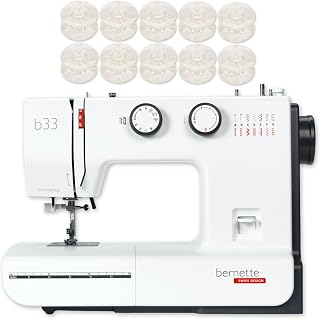
KEY FEATURES
- 15 stitches including a four-step buttonhole
- Mechanical dials and direct reverse lever
- Semi-automatic needle threader
- Free arm and retractable feed dogs
- Five presser feet included
PROS
- Owners repeatedly describe setup, threading and bobbin work as approachable
- Several comments call the machine sturdy and easy to learn
- One owner specifically found the manual helpful
CONS
- One beginner found pedal-only speed control difficult to moderate
- Owners report a missing cover or promised bonus bobbins
- One buyer describes receiving the wrong market-voltage version
Editorial Rating
Based on supplied customer reviews and verified product documentation
Price and availability subject to change
The Bernette B33 makes a sensible promise: keep everyday sewing controls physical, provide the stitches most beginners actually use, and avoid a screen. Its biggest learning issue is not threading or stitch selection. It is speed, because the foot pedal is the only way to control it.
The pedal is the learning curve
Bernette publishes a maximum speed of 860 stitches per minute. The B33 has no slider that caps that speed, so fine control depends on how gently the operator presses the pedal. One collected owner specifically found this difficult, while other supplied comments described the machine as easy to learn. Both can be true: the dials are straightforward even when smooth pedal control takes practice.
A new owner should begin on stable woven scraps and learn to start, slow and stop before attempting a curved seam. That is ordinary skills practice, not a reason to avoid the machine. A buyer with limited foot mobility or a strong preference for a fixed low-speed setting should choose a model with a speed slider.
Fifteen stitches cover the practical middle
The stitch set includes 14 utility or practical options and a four-step buttonhole. Maximum length is 4 mm and maximum width is 5 mm. This is enough for straight construction, zigzag finishing, selected stretch work, mending and restrained decorative use without turning stitch selection into a catalog exercise.
The buttonhole is deliberately manual compared with the one-step programs on computerized machines. The operator turns the selector through four stages and must judge the transitions. Someone making an occasional buttonhole may accept that; a garment sewer producing repeated matching buttonholes has a concrete reason to step up.
Mechanical controls trade automation for visibility
There is no start/stop button, programmable needle stop or display. In return, the setting dials and reverse lever remain visible and direct. A semi-automatic needle threader helps with threading, while the front-loading CB bobbin follows a traditional layout rather than the top drop-in style many beginners find easier to inspect.
The removable accessory storage exposes a free arm for cuffs and trouser hems. Feed dogs can be retracted for darning or compatible free-motion work. Five presser feet are listed as standard, which gives the machine a more complete everyday starting set than listings that make every alternate task an immediate accessory purchase.
What seven collected review texts can support
Several texts describe setup, bobbin threading and needle changes as approachable, and one specifically credits the manual. The language around sturdiness is encouraging but too general and too small a sample to support a longevity claim.
The useful cautions are operational. One buyer reports that a cover was absent; another says ten bonus bobbins promised by the marketplace bundle did not arrive. Those are bundle or fulfillment anecdotes, not B33 design defects, but they justify checking the exact accessory list as soon as the box is opened.
Voltage belongs on the checkout checklist
One supplied text describes receiving a 125-volt unit for use on 250-volt mains. We cannot verify the transaction or generalize it to all units. The safe implication is simple: market versions differ, and the rating plate and seller specification must match the intended electrical supply before the machine is connected. Do not improvise with an unspecified converter.
Where the B33 sits between basic and automated
Choose the B33 if tactile controls, a useful but contained stitch set and mechanical transparency matter more than buttonhole automation. It is a credible first machine for stable fabrics and routine garment work, provided the buyer is willing to develop pedal control.
Move to the computerized B37 when a speed limiter, start/stop sewing, needle stop up/down and several one-step buttonholes would materially improve the work. Move down to a cheaper basic mechanical model only after comparing included feet, feed-dog control and local support—not just stitch count.
- Practice the pedal on stable woven scraps before curves or detail work.
- Complete one buttonhole to decide whether the four-step process suits your workflow.
- Verify voltage and accessories before the return window closes.
Pros & Cons Analysis
Based on supplied customer reviews and verified product documentation
Pros
- Collected comments repeatedly describe threading the bobbin, changing the needle and starting the machine as manageable.
- Several owners use “sturdy” or similar language, although the short sample cannot prove long-term durability.
- One owner specifically credits the manual with making setup easier.
- Positive comments frame the B33 as a straightforward machine for learning conventional controls.
Cons
- One owner found it hard to sew slowly because speed depends on foot-pedal finesse rather than a limiting slider.
- A buyer reports that a cover was missing, and another says advertised bonus bobbins were absent from the shipment.
- One supplied account describes receiving a 125-volt unit for use on 250-volt mains, making checkout verification essential.
- The seven-text sample contains several vague positive comments and limited project detail.
Our Verdict
Bottom line
The B33 is a credible first mechanical machine for someone who wants visible controls and is willing to learn the pedal.
Customer feedback is strongest around approachable threading, bobbin setup and basic operation. The recurring limitation is speed control: there is no slider, and one beginner found the pedal difficult to moderate.
It fits you if
- You prefer physical dials to screens and menus.
- Your work centers on alterations, stable woven fabrics and ordinary garment seams.
- You are comfortable practicing starts, stops and curves on scrap fabric.
Look elsewhere if
- You need a fixed low-speed ceiling or start/stop sewing.
- You make many repeated buttonholes and want one-step automation.
- You cannot verify the delivered voltage and exact accessory bundle before use.
Make the first week count
Inspect the box promptly for the cover, five feet and any seller-promised extras, then confirm the rating plate before connecting power. Practice pedal starts and curves on stable woven scraps and complete a four-step buttonhole before the return window closes. Those checks address the most useful owner cautions without treating isolated fulfillment reports as defects in every B33.
The machine itself earns a positive beginner assessment, but direct mechanical controls are a fit decision, not proof that every learner will find speed easy.
Frequently Asked Questions
How many stitches does the Bernette B33 have?
Bernette lists 15 stitches: 14 utility or practical stitches plus one four-step buttonhole.
Does the B33 have a speed-control slider?
No. Sewing speed is controlled through the foot pedal, so a beginner must develop pedal control.
Can the feed dogs be lowered?
Yes. Bernette lists retractable feed dogs for darning and compatible free-motion work.
Does the package voltage work worldwide?
Do not assume so. Voltage varies by market and unit. Check the rating plate and seller documentation before plugging in the machine.
What do owners find easiest about the B33?
The supplied customer comments most often support setup tasks: threading, bobbin preparation, needle changes and understanding the manual. One beginner found pedal speed harder to moderate, so easy controls do not eliminate the need for practice.
Technical Specifications
| Machine class | Full-size domestic sewing machine |
|---|---|
| Control type | Mechanical dials and levers |
| Primary functions | Garment sewing, alterations, mending and basic decorative sewing |
| Built-in stitches / applications | 15 stitches including 1 buttonhole |
| Maximum sewing speed | 860 stitches per minute |
| Speed control | Foot pedal only; no speed slider |
| Maximum stitch length | 4 mm |
| Maximum stitch width | 5 mm |
| Needle stop up/down | No |
| Bobbin / looper system | CB hook with front-loading bobbin |
| Workspace right of needle | 170 mm |
| Included presser feet | 5 |
| Buttonholes / eyelets | 1 four-step buttonhole |
| Extension table | Not included |
| Needle threader | Semi-automatic |
Singer 4452 Review: The Accessory Bundle Is the Real Upgrade
Singer 4432 Black Review: Useful Stitch Range, Mixed Thick-Seam Control
Janome 2212 Review: Honest Beginner Simplicity With Feed Limits