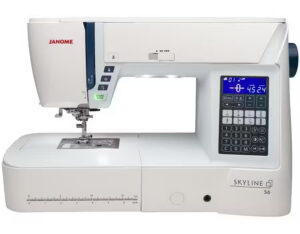
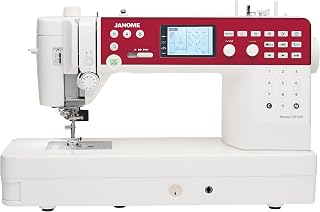
The original Janome Skyline S6 and MC6650 solve different sewing-room problems. Keep the S6 in contention when garment work needs a free arm and you want AcuFeed. Look more closely at the MC6650 when moving quilt bulk through a smaller opening is the frustration you want to solve.
What has to pass through the opening?
The MC6650 gives you 10 inches to the right of the needle; the original S6 gives you 8.25 inches. Both openings are 4.7 inches high. That is extra horizontal clearance, not extra height. An extension table can support the quilt outside either machine, but cannot change those internal dimensions.
Rolled quilt bulk
MC6650 owners describe completing large quilts, including a high-loft queen project. That makes its room relevant to a quilter handling substantial work. It does not establish that every quilt size or batting choice will be comfortable.
Cuffs and small tubes
The S6’s removable bed section exposes a free arm. The MC6650 stays flat. If you alternate quilting with narrow garment repairs, rehearse that handling difference before treating the larger opening as an automatic upgrade.
AcuFeed and an optional walking foot are different purchases
The original S6 includes an AcuFeed dual-feed foot and holder. The MC6650 uses SFS+ feed, and Janome lists its compatible even-feed attachment as optional. Do not transfer an AcuFeed claim from another Memory Craft model to the 6650.
That distinction matters when comparing actual packages. MC6650 owners mention buying a walking foot, table and knee lifter separately. Janome also lists the knee lifter as optional for the MC6650, whereas it is a standard S6 accessory. Ask for the packing list for the exact offer; customer descriptions of a dealer bundle are not a universal inclusion list.
Two different kinds of threader complaint
Some owners describe learning the thread path or a new threader technique and then getting useful results. Others report a threader that broke or remained unusable. A learning story cannot explain away a hardware-fault report.
What else should the service conversation cover?
The MC6650 accounts include repeated bobbin-area jams, broken needles and extended repair experiences. The S6 accounts include a loosening needle clamp and a separate report of poor operation. Ask who will inspect the machine, how a return differs from a warranty repair, and whether service requires shipping. Stop using a machine that repeatedly jams or breaks needles and follow its manual and service advice.
The evidence does not identify a reliability winner. The original listing files contain different numbers of accounts, and some describe upgrades or other model numbers. Those mismatched accounts have been excluded from the product conclusions below.
Try the same three tasks on both
- Your awkward project: bring the rolled quilt section or narrow garment opening that currently causes trouble. Compare handling, not just a flat demonstration seam.
- A complete restart: thread from the manual, change the bobbin, and sew at a controlled pace. Exercise the cutter and needle-stop controls you expect to use.
- A packing-list check: identify each compatible foot, knee lifter and table in the offer. Then consider how you will move or service the machine.
Both have speed sliders, memorized needle positioning and automatic cutting. Those shared conveniences do not decide this pair. Neither weight—23.8 pounds for the S6 and 24.25 pounds for the MC6650—suggests a substantial portability advantage. For a broader shortlist, the quilting-machine guide separates portable choices from permanent stations.
Manufacturer references and model scope
Specifications and standard/optional accessories follow Janome’s original Skyline S6 documentation and MC6650 documentation. Customer experiences describe individual outcomes; they do not establish comparative failure rates or measured performance.
