Sewing Machine Guide

  • Home
  • Reviews
  • Best
    • All Best Picks
    • Computerized
    • Embroidery
    • Mechanical
    • Quilting
  • Guides
    • All Sewing Guides
    • Computerized
    • Embroidery
    • Mechanical
  • Comparisons
    • All Comparisons
    • Computerized
    • Embroidery
    • Mechanical
    • Straight-Stitch
  • Favorites
Guides

Sewing Over Thick Seam Intersections: Why the Foot Tilts

2 min read
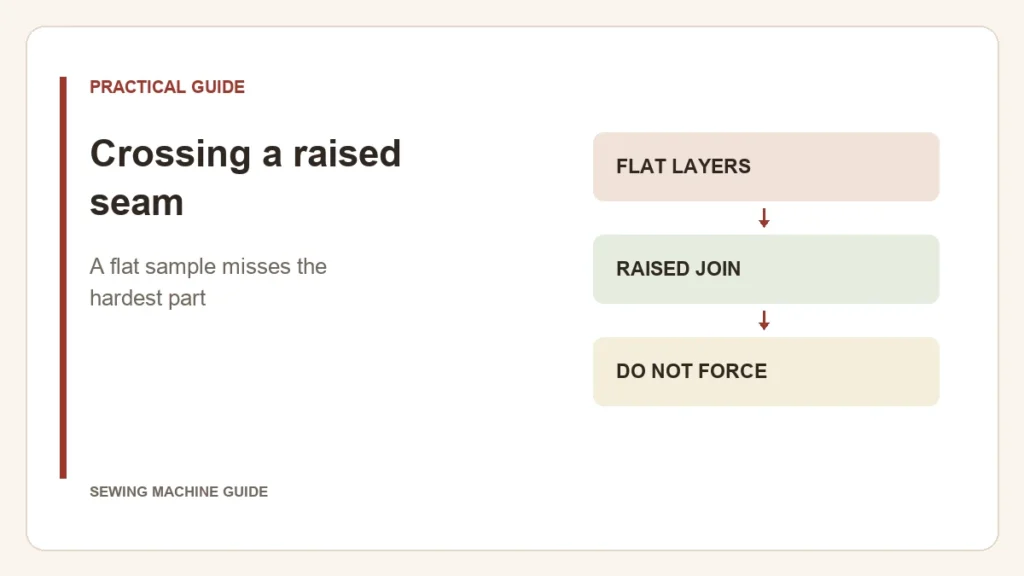
Editorial diagram: Crossing a raised seam. flat layers, raised join, do not force.

Table of Contents

Two flat layers can sew easily while their folded seam intersection stalls. At the crossing, the foot climbs a step, the stack thickens and contact with the feed system changes. Stop at the first sign of force and identify which limit you have reached.

Which of these describes the obstruction?

The stack will not fit comfortably under the foot

This is a clearance problem. Do not compress the work forcibly or pull it under the needle. Reconsider the seam construction or have the actual assembly assessed on a suitable machine. Raising a foot farther for insertion does not establish that the machine can sew the stack.

The stack fits, but the foot tilts and the fabric stops advancing

A permitted leveling feature or height-compensation aid may help the foot stay in useful contact as it climbs the step. It changes the angle; it does not increase motor capability or create more needle clearance. Check the exact machine and accessory instructions before using it.

The needle bends, stalls or strikes something

Stop sewing. Check the needle, foot, plate and material combination against the manual. Do not force the handwheel, pull the fabric through or keep increasing pedal pressure. An abnormal strike needs correction before another attempt.

What a leveling feature actually does

The Brother NX-650/650Q manual illustrates a holding pin on its zigzag foot for maintaining a level position at a thick start. That is an exact accessory example; a similar-looking foot may not have the mechanism.

Brother’s heavyweight-fabric guidance also warns against forcing fabric. A machine continuing to make needle holes while the work is stuck is not successfully crossing the seam.

The sample must contain the step

Recreate the folds, allowances, interfacing and direction of travel from the difficult join. A flat pile of denim misses the very obstacle you are evaluating. With the recommended needle and thread, the sample should advance and form sound stitches without pushing or pulling.

If the assembly exceeds the machine’s comfortable capability, examine whether the pattern permits a less bulky finish or a different order of construction. Do not trim structural allowances indiscriminately. For repeated heavy joins, take the sample to a dealer; fabric names and layer counts alone cannot decide the purchase.
Share this article

Twitter Facebook LinkedIn Email

Related Articles

Simplified editorial diagram: Catch the binding edge. Inspect both faces.

Machine Quilt Binding Missing the Back Edge? Change What You Can See

Read More
MIRABIN sewing machine and supplied offer accessories

Why a New Sewing Machine May Arrive Threaded with Fabric

Read More
Editorial illustration: Needle threader checks. Position before force.

Automatic Needle Threader Not Working: Check Compatibility and Position

Read More

About Sewing Machine Guide

Independent sewing machine reviews and practical buying guidance.

Your trusted source for honest, in-depth product reviews and comparisons.

Quick Links

  • Home
  • Reviews
  • Best Articles
  • Comparisons
  • Guides
  • About
  • Contact
  • Privacy Policy

Categories

  • Computerized Sewing Machines
  • Coverstitch Machines
  • Embroidery Machines
  • Handheld Sewing Machines
  • Industrial
  • Mechanical Sewing Machines

© 2026 Sewing Machine Guide. All Rights Reserved.

As an Amazon Associate I earn from qualifying purchases. We may also earn from other retailer links. Affiliate disclosure