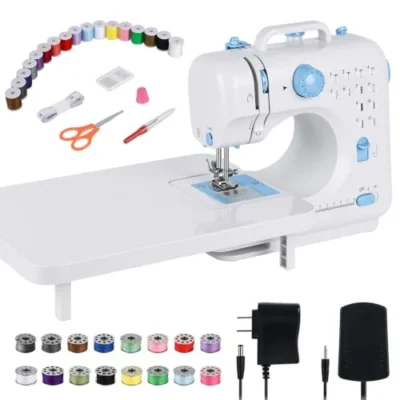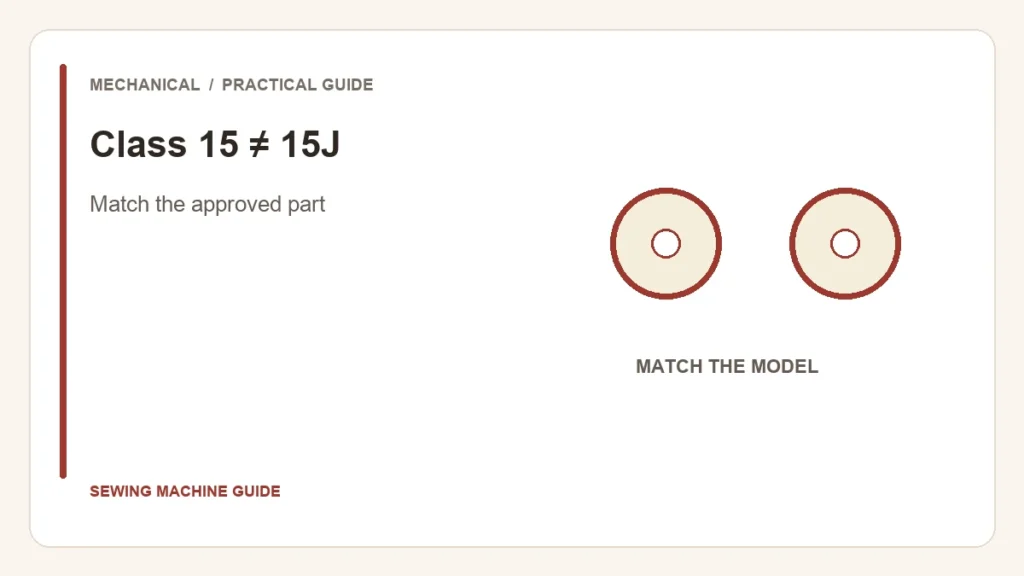
Do not substitute Class 15 and Class 15J because they look close or fit inside the opening. Match the exact bobbin type and material specified for your machine. A case closing is not a compatibility test.
Read the specification before the dimensions
Singer’s bobbin guide distinguishes transparent Class 15, Class 15J, metal Class 15 and Class 66, and warns against substituting these styles. It describes different profiles as well as materials. Approximate ruler measurements are not a replacement for the approved class or part number.
| Information | Where to obtain it |
|---|---|
| Exact machine model | The machine’s identification label. |
| Approved bobbin | Its manual, parts list or manufacturer support. |
| Material requirement | The same approved specification—not a strength preference. |
| Replacement listing | A matching part number or explicit exact-model compatibility. |
| Prewound option | Separate confirmation of bobbin format and suitable thread. |
Sort an unlabeled collection without gambling
- Keep known, labeled bobbins with the machine they belong to.
- Separate unidentified bobbins rather than mixing them into the ready-to-use supply.
- Compare the original documentation and replacement part information.
- If identification remains uncertain, obtain a confirmed replacement instead of test-sewing an unknown one.
This is particularly useful when two household machines share a sewing table. A nearly identical spare can move between kits unnoticed. Label the storage box with the machine model and bobbin specification rather than only the thread color.
The correct bobbin still needs correct winding
Singer’s winding guidance emphasizes the winding tension path and an evenly wound bobbin. It also explains why the correct style matters before winding. A loose or irregular wind should not be treated as evidence that a different bobbin class is needed.
- Use an undamaged approved bobbin.
- Wind through the exact machine’s specified guides.
- Avoid overfilling and inspect for an uneven or loose wind.
- Insert it in the documented direction and seat the thread in its channel.
Do not use tension to compensate for the wrong part
If trouble began after a bobbin change, establish compatibility and seating before adjusting tension. The bunching guide separates that baseline from other causes of a nest. If the original bobbin type is unknown, resolve the part identity first; the next useful step is not another random dial setting.