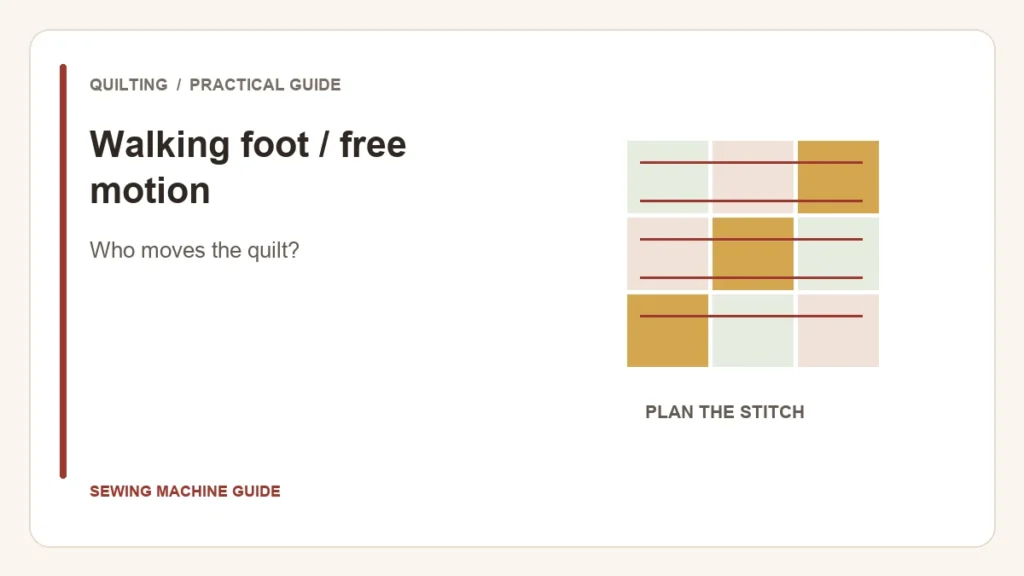
Choose the movement method from the quilting path you want to sew. A walking-foot setup works with machine feeding. In free motion, you guide the sandwich through the path using a supported free-motion setup. Neither is a compulsory skill level before the other.
Draw the path before choosing the foot
| Planned quilting | Method to investigate | Main handling question |
|---|---|---|
| Parallel lines or a broad flowing path | Walking foot or supported dual feed | Can you guide the bulk through turns without dragging? |
| Loops, stippling or frequent changes of direction | Free motion | Can you coordinate hand movement and stitching? |
| A mixture of borders and interior motifs | Both, in planned stages | Can you change setups without losing the project’s sequence? |
Walking-foot work is not limited to a plain grid. BERNINA’s no-mark quilting lesson demonstrates a design made with its walking foot. The useful boundary is how the fabric is fed, not whether the final pattern looks decorative.
Free motion changes the source of movement
In ordinary unregulated free motion, moving the fabric faster relative to the needle produces wider stitch spacing; moving it more slowly produces shorter spacing. BERNINA’s introductory free-motion lesson uses a compatible quilting foot and disabled normal feeding on its illustrated machines. Use the arrangement approved for your model, which may differ.
Practice the line
Try a simple, repeated shape so you can notice changes in hand speed.
Practice the pause
Stop, reposition your hands and resume without pulling the work against the needle.
Compare two small samples before committing
- Prepare two similarly basted sandwiches with the intended top, backing and batting.
- Use the exact foot, feed arrangement and operating instructions for each method.
- Sew a path representative of the design—not only a straight line if the project needs curves.
- Inspect both surfaces for stitch formation, tucks and layer movement.
- Repeat with representative bulk in the machine opening. A small sample establishes less about handling than about the stitch.
Keep any speed or stitch settings with the sample. Do not copy settings from another machine simply because its foot has a similar name. Foot compatibility and clearance remain separate checks.
Choose the method you can repeat comfortably
Use machine-fed quilting when it suits the path and helps you guide the layers consistently. Use supported free motion when changing direction freely is central to the design. If the machine’s capability is still uncertain, assess whether your regular machine can perform the planned quilting work before buying attachments. An unfamiliar method needs practice; an unsupported attachment needs a different solution.