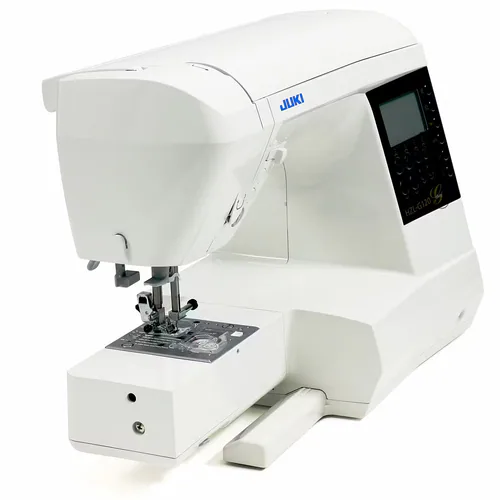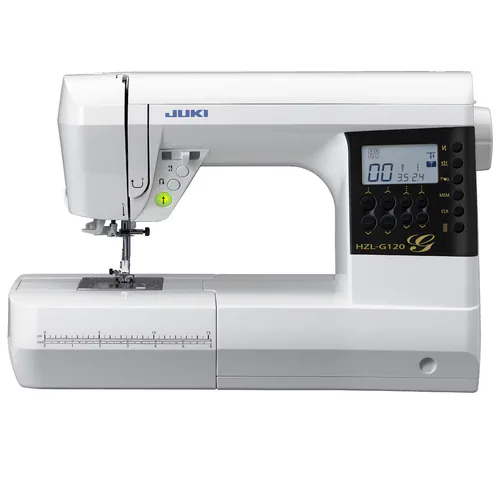
The HZL-G120 makes sense to investigate when the space beside the needle matters more than a compact carrying size. Owner comments support that distinction. They do not establish that its box-feed system handles every thick seam without adjustment.
Start with the work you need to fit
Darlene Young describes replacing an older machine and appreciates the throat space. Sandra also values the larger working area, but explicitly says she has not yet tested heavy fabrics. Her confidence in another Juki is not a test of this G120.
That distinction matters for quilting: room to arrange a project and the ability to sew through a bulky intersection are different questions. Bring the kind of work you expect to handle to a demonstration, rather than treating a workspace comment as a fabric-capacity result.
What changes around ordinary stitching
Threading and setup
The account posted as Happy Customer describes an early trial with easy bobbin and machine threading. The buyer wanted zigzag and other stitches alongside an existing straight-stitch machine. This is a practical reason for the G120’s broader functions, although the hoped-for years of service were still an expectation.
Running feel
Johnette Rowland reports sewing without the hesitation and stopping she disliked. Happy Customer describes quiet running. These are favourable individual experiences, not a measured noise comparison or a guarantee against interruptions.
Read the G120 specification without the promises
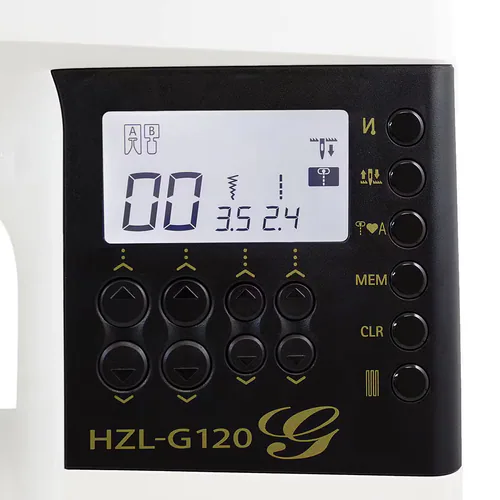
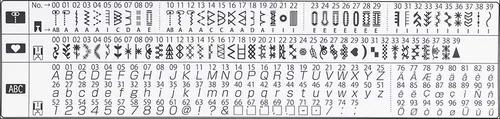
Juki’s G120 specification lists 180 patterns, one font, a maximum speed of 900 stitches per minute and maximum stitch dimensions of 7mm wide by 5mm long. The listed weight is 20 pounds. Its box feed is a feeding mechanism, not proof that puckering or shifting cannot occur.
Buttonhole count and accessory terminology
Juki’s product specification lists seven buttonholes, while the G-series brochure describes eight types. Check the exact machine’s pattern chart if a particular style matters. Also, “low shank” describes the presser-foot fitting; it is not the needle system.
Pros & Cons Analysis
Reasons supported by owners
- Useful working space: Darlene and Sandra independently identify room around the sewing area as a benefit. Neither account establishes clearance for every quilt.
- Accessible initial setup: the early threading experience supports considering it as a move into a broader stitch range.
- Positive running experience: Johnette’s report addresses interruptions during sewing, beyond a generic statement of satisfaction.
Boundaries to the recommendation
The seven merchant accounts do not supply a detailed adverse machine experience. They also do not substantiate the previous claim of effortless thick-denim performance. Sandra Medel’s planned quilting and Lisa Auckland’s value comment do not add completed-project or current-price evidence. At the documented 20-pound weight, assess carrying comfort separately from workspace suitability.
Our Verdict
Put the G120 on your shortlist for a larger working area and a wider sewing repertoire than a straight-stitch machine. The most useful owner evidence concerns space, threading and running feel. If bulky layers are the main reason for buying, make a representative seam demonstration the deciding step; the available feedback does not answer that question for you.
Product illustrations