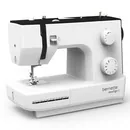
The bernette sew&go 1 is the mechanical entry model in its family. Its appeal is a limited, visible set of sewing controls—not the unspecified “automatic features” previously claimed on this page. Decide whether its stitch selection and manual routine fit the work you expect to do.
Follow a buttonhole through all four steps
The manufacturer’s family comparison identifies one four-step buttonhole for the sew&go 1. That distinction matters if repeated garment buttonholes are a major task: the operator manages the stages rather than using the one-step system listed for the sew&go 5.
Ask to sew a complete sample on the intended fabric and stabilizer. Judge whether you are comfortable repeating the sequence and obtaining the size you need; the number of stages alone does not establish the quality of the finished opening.
Read the sew&go 1 column, not the family headline
Documented controls
The model page lists 10 stitches and a 5 mm maximum stitch width. The brochure also lists manually adjustable upper-thread tension and presser-foot pressure.
Automation absent from this model
The family table marks no built-in threader, start/stop button, needle-stop up/down or slide speed control for the sew&go 1. Those features on another sew&go model must not be attributed to this one.
Check the stitch chart and accessories against your projects
Bernette lists four standard presser-foot soles, including zipper and buttonhole feet. Match the required operation to the actual stitch chart and included foot. The broader compatible-accessory catalog is not a list of everything supplied with the machine, and an accessory name does not add a computerized sewing function.
Pros & Cons Analysis
A focused selection for basic sewing
A short stitch menu can suit someone whose work uses a small set of seams and who wants to learn the controls directly. That is a fit consideration, not proof that every beginner will find setup easy.
Convenience features may matter more than stitch count
If threading assistance, a speed slider or one-step buttonholes are priorities, this specification is a poor match. Compare those functions explicitly rather than buying on the family name or hoping optional feet will supply them.
Our Verdict
Shortlist the sew&go 1 for basic projects when its manual controls and four-step buttonhole suit your routine. Choose on the needed stitch and control functions before comparing accessories.
The manufacturer documentation supports these features, not the former claims of universal suitability or effortless precision. No exact-model customer corpus was established for this repair, so durability and ease-of-learning outcomes remain unverified.