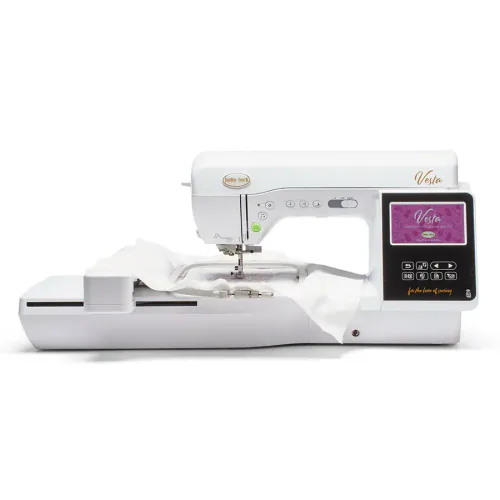
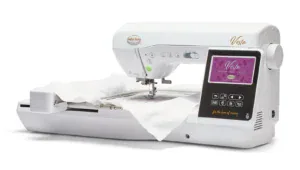
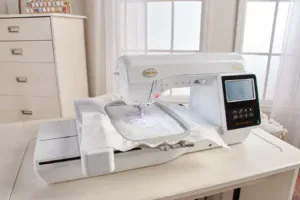
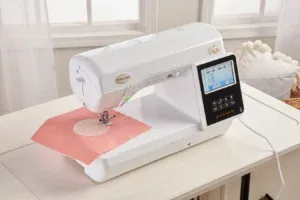
The Vesta combines ordinary sewing and hoop embroidery. Its strongest buying case is a routine that uses both: constructing an item, then adding a design that fits its embroidery field. A long feature list matters less if one half of the machine would sit unused.
Plan the design before choosing the machine
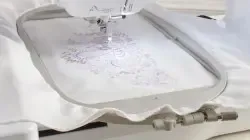
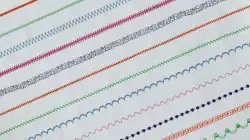
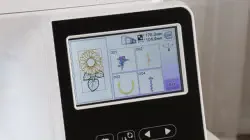
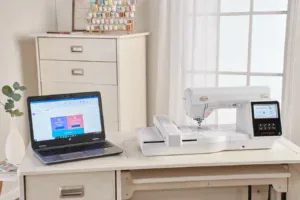
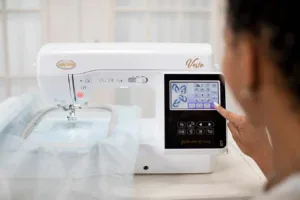
Baby Lock lists a 6¼ × 10¼-inch embroidery field, 293 built-in designs, 14 embroidery fonts and 301 sewing stitches. Those are separate capabilities; sewing patterns should not be counted as additional hoop designs. Design Database Transfer provides a wireless route from a computer.
Start with the dimensions of the design you actually want to stitch. A larger motif or border may require a different layout or multiple hoopings. Transferring a design also does not turn an ordinary picture into a stitch-ready embroidery file.
Color Sort reduces changes within its limits
The Vesta instruction guide, printed page104, explains that Color Sort rearranges the sequence by thread colour to reduce spool changes. It does not alternate unnecessarily between colours, as this page previously claimed. The manual explicitly excludes overlapping designs from this function.
Separated motifs
A layout with several independent motifs is a useful reason to investigate sorting. The benefit concerns the sequence of colours, not a promise that an entire job becomes unattended.
Layered designs
When elements overlap, their stitching order can matter. Do not choose the Vesta on the assumption that Color Sort will simplify every composition.
Pivoting holds the needle down while you turn
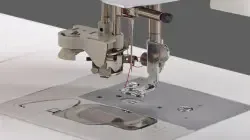
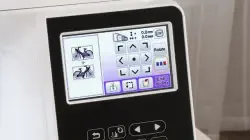
With the pivot function selected and the required settings in place, stopping leaves the needle in the fabric and raises the presser foot. You turn the fabric; the machine does not swing the needle around the corner. Printed page41 describes the operating sequence and its restrictions.
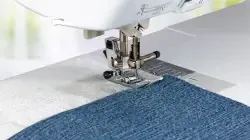
The fabric sensor section on printed page40 concerns automatic presser-foot pressure. It does not establish that the machine identifies every fabric or guarantees correct tension and perfect stitches without preparation.
What the owner accounts support
Baby Lock’s three displayed owner entries are positive: CLK describes family sewing and embroidery use; Patti likes the instructions; MyVesta reports a successful first dragonfly embroidery while still learning. These support an approachable learning experience for those owners, not commercial throughput or a long-term reliability forecast.
Moving the complete setup
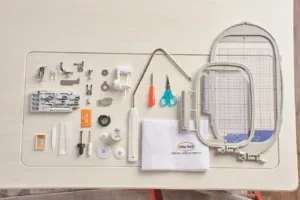
The manufacturer lists 22 pounds for the machine alone and 30 pounds with its embroidery unit. Allow for accessories and the space needed around the setup when planning classes or storage.
Pros & Cons Analysis
Advantages
- Two related activities in one purchase: The owner comments describe both sewing and embroidery. That makes the combination relevant to someone who genuinely wants both, while a sewing-only buyer should weigh how much of the equipment would go unused.
- Instructions appreciated by an owner: Patti’s comment and MyVesta’s successful first embroidery support the possibility of learning the machine. They do not remove the need to understand hooping, stabilizer and design preparation.
Limitations
- Sorting does not cover overlapping designs: The manual’s restriction matters when lettering and motifs share space. Plan around the actual composition rather than assuming every colour change can be removed.
- A substantial complete setup: The embroidery unit adds to the carrying load. Think about the whole kit, not only the machine body, if frequent travel is important.
Product illustrations




Our Verdict
Choose around the projects that use both modes
The Vesta is worth considering for sewing plus medium-format hoop embroidery when the design area and handling controls fit your work. If your designs exceed the field or your work depends on overlapping colour-sorted layouts, resolve those limits before purchasing.